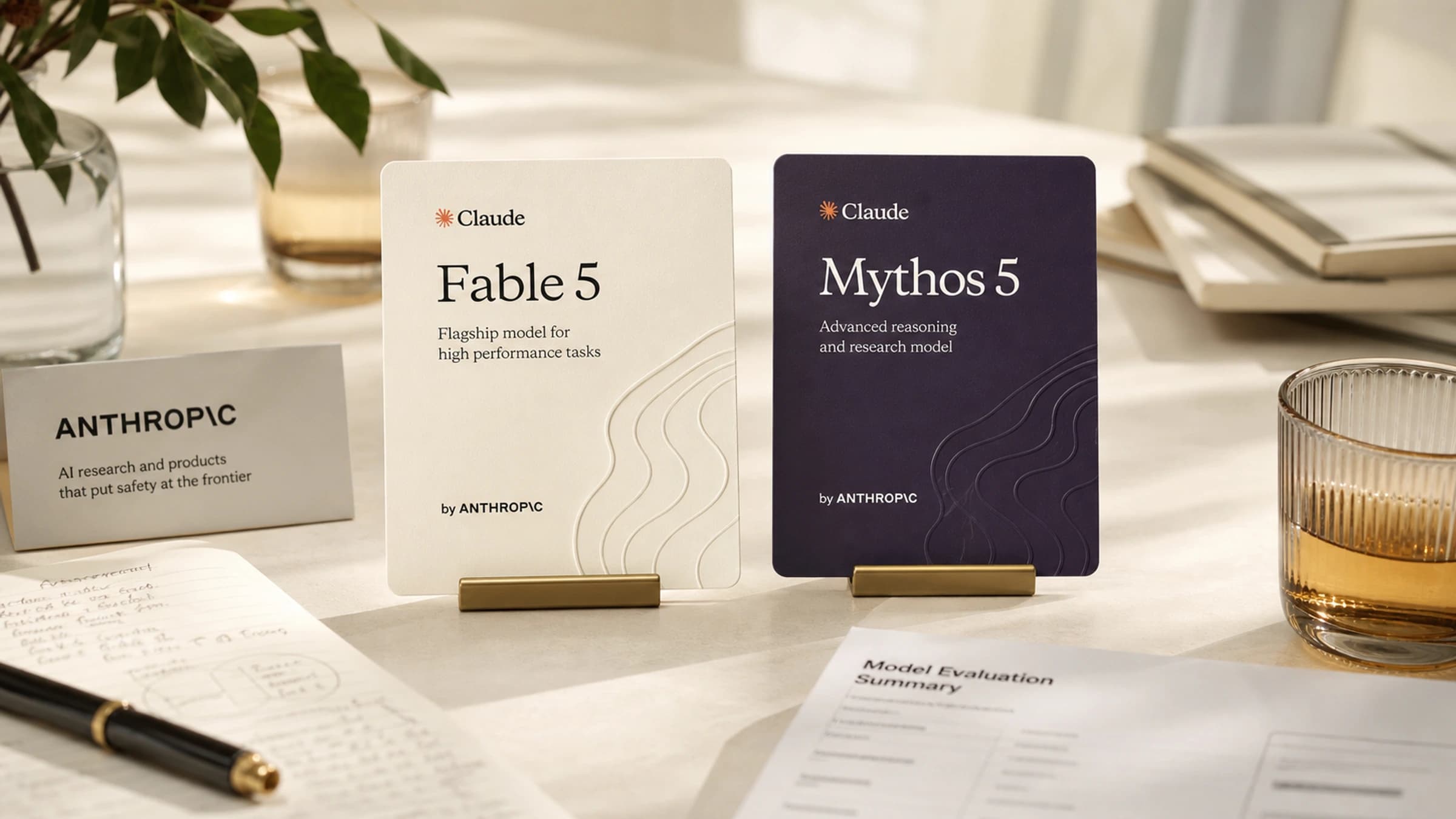

Anthropic has launched Claude Opus 4.8, a new version of its most capable public Claude model, with a clear message for developers: this release is less about a single flashy benchmark and more about making long-running agent work feel more dependable.
The model was announced on 28 May 2026 and is available now through Claude, Claude Code and the Claude API. Anthropic says regular API pricing is unchanged from Opus 4.7 at $5 per million input tokens and $25 per million output tokens, while fast mode is now priced at $10 per million input tokens and $50 per million output tokens.
The launch matters because it lands in the middle of a shift from chatbots to agents. Anthropic is trying to position Opus 4.8 as the model that can plan, verify, challenge weak assumptions and keep working across larger coding and professional tasks without drifting off course.
Claude Opus 4.8 Launch Quick Summary
Claude Opus 4.8 is Anthropic's latest Opus model, launched on 28 May 2026. It focuses on stronger coding and agentic workflow performance, adds Dynamic Workflows for Claude Code, gives Claude users effort controls, keeps regular API pricing unchanged from Opus 4.7 and makes fast mode cheaper than previous fast-mode pricing.
What Anthropic announced with Claude Opus 4.8
Claude Opus 4.8 is pitched as an upgrade over Opus 4.7 across coding, agentic tasks, reasoning and professional knowledge work. Anthropic says the model is a better collaborator, with improved judgement and a stronger tendency to flag uncertainty rather than overstate progress.
The launch includes four practical product updates:
- Opus 4.8 availability across Claude products and the Claude API.
- Dynamic Workflows in Claude Code, a research preview for large multi-step coding tasks.
- Effort control in claude.ai and Claude Cowork, letting users choose how much work Claude puts into a response.
- A Messages API update that allows system entries inside the messages array, so developers can update instructions mid-task.
For developers, the most important model identifier is claude-opus-4-8. Anthropic’s model documentation lists Opus 4.8 as its most capable option for complex reasoning, long-horizon agentic coding and high-autonomy work.
Why the Opus 4.8 coding and agent claims matter
The interesting part of Opus 4.8 is not that Anthropic says it performs better. Every frontier model launch says that. The more important claim is that the model is more reliable at the messy parts of real work: asking clarifying questions, catching its own mistakes, challenging a poor plan and carrying context through long sessions.
That is exactly where agentic coding tools tend to succeed or fail. A model can write a function quickly and still be a poor engineering assistant if it misses integration risk, ignores tests, makes brittle assumptions or claims it has finished work that it has not verified.
Anthropic says Opus 4.8 is around four times less likely than its predecessor to allow flaws in code it has written to pass unremarked. That is a meaningful claim, but it should be read carefully. It comes from Anthropic’s own evaluations and needs to be tested by independent users across real repositories, legacy systems and production review processes.
Still, the direction is notable. The frontier race is moving from raw answer quality towards operational dependability. Developers do not just want a model that can produce code. They want a model that knows when to stop, when to check, when to ask and when to say the evidence is not strong enough.
Dynamic Workflows pushes Claude Code towards bigger jobs
The most substantial product change is Dynamic Workflows for Claude Code. Anthropic describes it as a way for Claude to plan a large task, run tens or hundreds of parallel subagents in a single session, check the work and report back.
In practical terms, this aims at jobs such as:
- investigating bugs across a large codebase;
- planning migrations across many files or services;
- stress-testing an implementation plan from multiple angles;
- comparing possible fixes before making changes;
- running broader analysis before a merge decision.
Anthropic says Dynamic Workflows are available in research preview in Claude Code CLI, Desktop and the VS Code extension for Max, Team and Enterprise plans where enabled, as well as through the Claude API, Amazon Bedrock, Vertex AI and Microsoft Foundry.
There is an important caveat. Anthropic warns that Dynamic Workflows can consume substantially more tokens than a typical Claude Code session. That means the feature may be powerful for codebase-scale work, but it will also need careful scoping, budget controls and human review.
Effort control makes the cost-quality trade-off explicit
Effort control is another sign that model products are becoming more configurable. Instead of one default behaviour for every task, Claude users can choose lower-effort responses when speed and rate-limit conservation matter, or higher-effort responses when quality matters more.
Anthropic says Opus 4.8 defaults to high effort because it sees that as the best balance of quality and user experience. For teams, the real value may be workflow design. A quick research pass, a code review and a production migration should not necessarily use the same depth of reasoning.
This also makes AI cost management more visible. If users can choose effort level, product teams can start matching model spend to task risk. A low-stakes summary can be cheap and fast. A multi-service refactor can justify more tokens, more checks and slower execution.
Claude Opus 4.8 Pricing and availability
For regular API usage, Opus 4.8 keeps the same price as Opus 4.7: $5 per million input tokens and $25 per million output tokens. Anthropic says fast mode runs at 2.5 times the speed and is now three times cheaper than it was for previous models, with pricing listed at $10 per million input tokens and $50 per million output tokens.
That pricing story is subtle. The standard price continuity helps developers upgrade without rewriting budgets around a more expensive flagship model. The fast mode pricing could matter for workflows where latency has been the blocker, although the real cost will depend on prompt size, tool use, retries, agent loops and whether Dynamic Workflows multiply token consumption.
Availability is broad. Anthropic says Opus 4.8 is available everywhere today, and the developer docs list support across the Claude API, AWS Bedrock and Google Vertex AI. Microsoft Foundry is also named in Anthropic’s Dynamic Workflows availability notes.
The bigger competitive signal
The Opus 4.8 launch also says something about the cadence of frontier AI releases. TechCrunch notes that Opus 4.8 arrived just 41 days after Opus 4.7, which is unusually fast for Anthropic. Whether that reflects faster iteration, competitive pressure or a need to respond to user feedback, it reinforces how quickly the model market is moving.
For customers, faster iteration is both useful and awkward. It means better models can arrive quickly, but it also means teams need stronger evaluation harnesses. If a model changes every few weeks, organisations cannot rely on generic benchmark claims. They need task-specific tests for their own codebases, documents, policies and risk tolerance.
What still needs scrutiny
There are three areas to watch after the launch.
First, independent evaluation. Anthropic’s benchmarks and early tester quotes are useful, but they are still launch materials. Developers should compare Opus 4.8 against Opus 4.7, Sonnet, GPT-5.5, Gemini and other tools on their own repositories and workflows.
Second, agent cost. Dynamic Workflows sounds compelling, but parallel subagents can burn through tokens quickly. The feature could be excellent for high-value migrations and investigations, while being wasteful for poorly scoped tasks.
Third, reliability under pressure. Anthropic’s honesty framing is important because unsupported progress claims are one of the most frustrating failure modes in coding agents. The question is whether Opus 4.8 meaningfully reduces that problem outside Anthropic’s evals and partner demos.
What Claude Opus 4.8 means for developers now
Teams already using Claude Code should treat Opus 4.8 as an upgrade worth testing, particularly for code review, migration planning, deep debugging and large context investigations. The safest path is to run it against a known set of internal tasks where previous Claude models struggled, then compare output quality, tool use, cost and human intervention.
For everyone else, the launch is another sign that the useful frontier is moving towards supervised autonomy. The best models are no longer judged only by whether they can answer a prompt. They are judged by whether they can do useful work, admit uncertainty, verify their outputs and fit into the economics of real teams.
Claude Opus 4.8 does not settle that question. But it gives Anthropic a sharper story in the most important battleground for AI tools right now: agents that can work longer, check themselves more often and make fewer confident mistakes.

About the author
Hi, I'm Jason Futrill.
I'm an tech professional and commentator exploring how intelligent systems are reshaping work, creativity, and society.
More about me