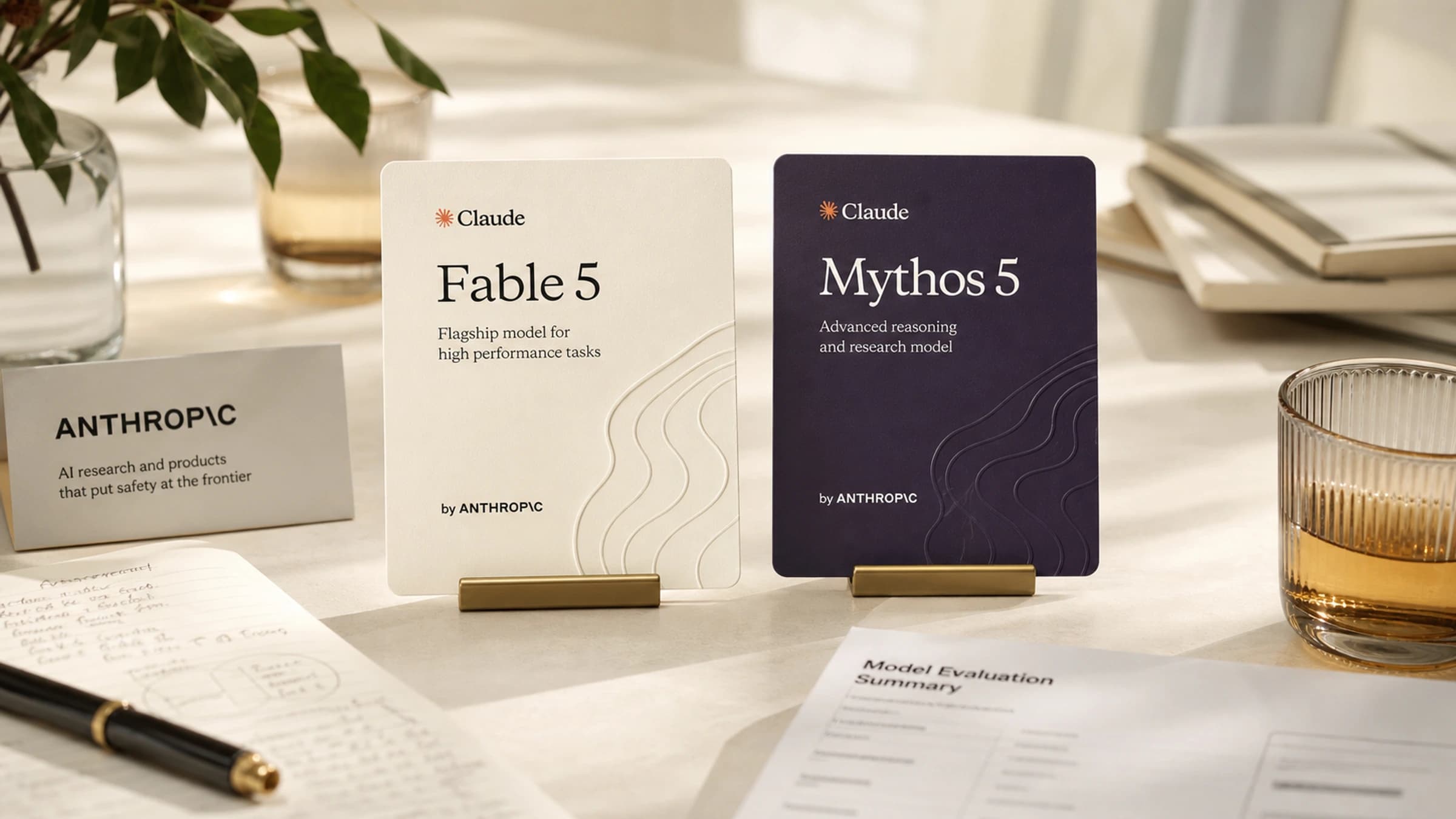
Anthropic has just split its newest Claude release into two names, and that is the part worth paying attention to.
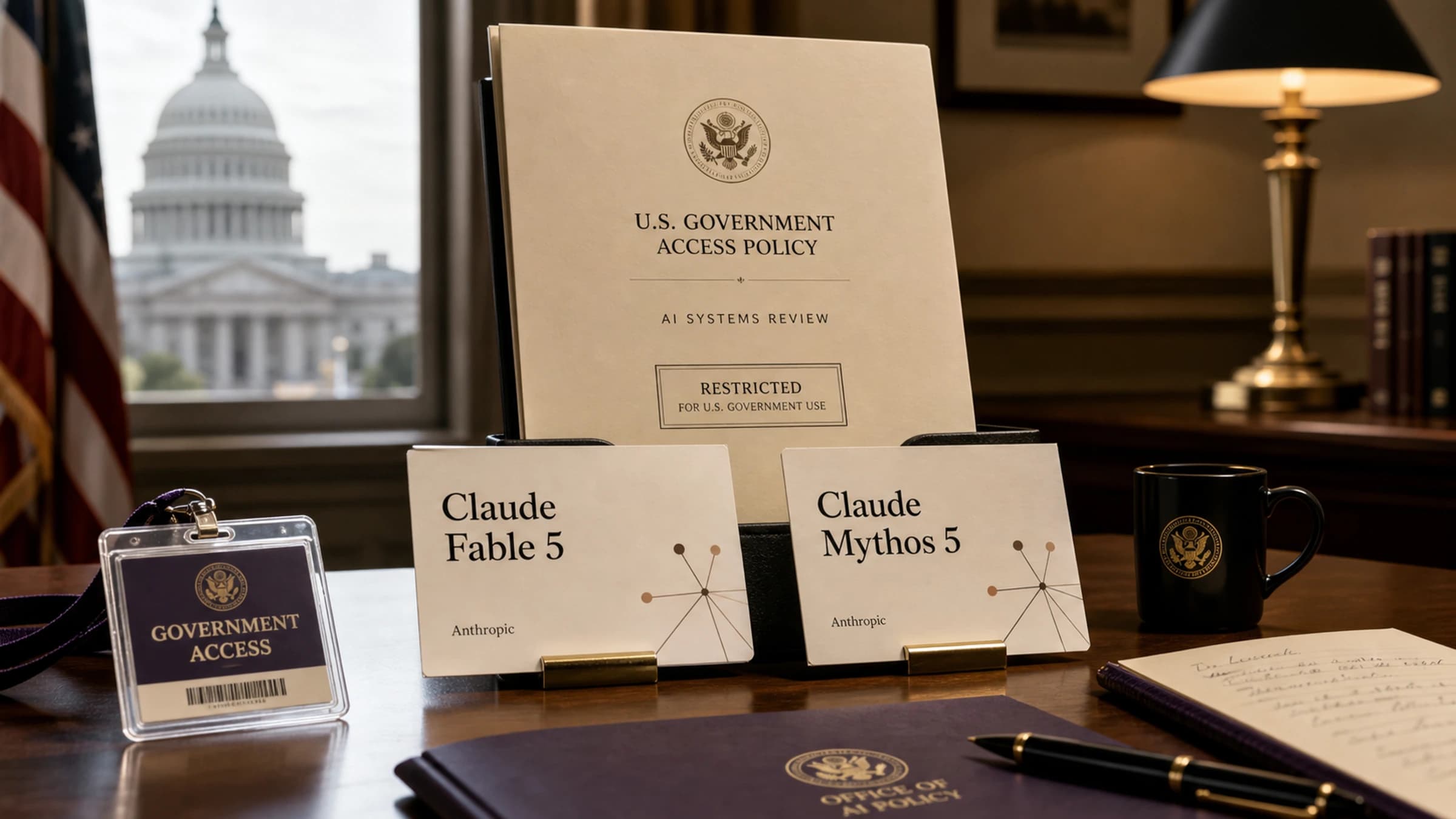
Claude Fable 5 is the model most people will actually be able to use. Claude Mythos 5 is the less restricted version, reserved for vetted partners working in areas such as defensive cybersecurity and, soon, selected biology research.
Under the hood, Anthropic says both models come from the same Mythos-class system. The difference is not that Fable is the little sibling. The difference is what Anthropic lets it do.
That makes this release more interesting than a normal benchmark victory lap. Anthropic is trying to ship its highest-capability model to the public while carving out the parts it considers too risky for open access.
The short version : What are Claude Fable 5 and Mythos 5?
- Claude Fable 5 is Anthropic's most capable widely released model.
- Claude Mythos 5 is the same underlying model with some safety restrictions lifted.
- Fable 5 is generally available from 9 June 2026 across Claude API, Claude Platform on AWS, Amazon Bedrock, Vertex AI and Microsoft Foundry.
- Mythos 5 is limited to approved customers through Project Glasswing.
- Both models support a 1 million token context window and up to 128,000 output tokens per request.
- Both are priced at USD $10 per million input tokens and USD $50 per million output tokens.
- Fable 5 adds safeguards for risky domains such as cybersecurity, biology and chemistry.
- Some Fable 5 requests can be refused or routed to Claude Opus 4.8 instead.
- Both models require 30-day data retention and are not available under zero data retention.
Fable 5 vs Mythos 5
| Area | Claude Fable 5 | Claude Mythos 5 |
|---|---|---|
| Public positioning | Widely released Mythos-class model | Restricted Mythos-class model |
| Underlying model | Same underlying model as Mythos 5 | Same underlying model as Fable 5 |
| Access | General availability | Limited to approved customers |
| Best fit | Long-running coding, research, knowledge work, enterprise workflows | Vetted defensive cybersecurity and selected scientific research |
| Safeguards | Extra classifiers and routing in high-risk domains | Some safeguards lifted for trusted programs |
| API model ID | claude-fable-5 | claude-mythos-5 |
| Context window | 1M tokens | 1M tokens |
| Max output | 128k tokens | 128k tokens |
| Price | $10 input / $50 output per million tokens | $10 input / $50 output per million tokens |
| Data retention | 30 days required | 30 days required |
The naming is slightly awkward, but the product logic is clear enough: Fable is the public version of a model class Anthropic now considers above Opus. Mythos is the trusted-access version for domains where the model's capability is useful and dangerous at the same time.
What Claude Fable 5 is for
Fable 5 is pitched at the jobs that usually break normal chat-model workflows: long projects, messy codebases, huge documents, multi-step analysis and agent runs that need to keep going without a human nudging every five minutes.
The model is meant for:
- large software migrations
- long-horizon autonomous coding
- complex implementation work
- deep research and analysis
- finance, legal and analytics workflows with dense documents
- visual work involving diagrams, charts, tables, PDFs and design comparison
- agent harnesses such as Claude Code and Claude Managed Agents
The part I would watch is not the benchmark table. It is the claim that Fable 5 can work for days in an agent harness, plan across stages, check its own progress and build tests or evaluations for its own work.
If that holds up in real use, this is less about a smarter chatbot and more about Anthropic pushing Claude further into project execution.
What Claude Mythos 5 is for
Mythos 5 is not the model most teams will be able to open in the console and start using.
It is restricted to approved customers, initially through Project Glasswing. That program is aimed at defensive work on critical software and infrastructure. Anthropic has also said it plans trusted access for selected biology researchers.
The reason is obvious from the system card. Anthropic says Mythos-class capability creates higher risk in areas such as cybersecurity, chemical and biological misuse, model distillation and advanced AI development assistance.
So Mythos 5 is the more direct version of the model, but it sits behind a trust gate.
Why Anthropic split the release
This is the important bit.
Anthropic wants to sell a model above Opus into mainstream coding and knowledge work, but it does not want to give every user the same level of help in high-risk technical domains.
Fable 5 is the compromise:
- You get the general reasoning, coding, long-context and agentic capability.
- Anthropic adds classifiers for sensitive areas.
- Some requests are refused.
- Some requests are routed to Opus 4.8 instead of Fable 5.
- Anthropic keeps 30 days of data for safety monitoring.
That is a fairly big product trade-off. For most business users, it may barely matter. For security researchers, bio researchers and developers building sensitive tooling, it matters a lot.
Pricing and limits of Fable 5 and Mythos 5
| Item | Claude Fable 5 | Claude Mythos 5 |
|---|---|---|
| Input tokens | $10 / MTok | $10 / MTok |
| Output tokens | $50 / MTok | $50 / MTok |
| 5 minute cache write | $12.50 / MTok | $12.50 / MTok |
| 1 hour cache write | $20 / MTok | $20 / MTok |
| Cache hit / refresh | $1 / MTok | $1 / MTok |
| Context window | 1M tokens | 1M tokens |
| Maximum output | 128k tokens | 128k tokens |
That is double the Claude Opus 4.8 token price listed in Anthropic's pricing table, but Anthropic is clearly positioning Fable and Mythos as a higher tier.
One useful detail: Anthropic says the full 1M token context window is included at standard per-token pricing. A 900k-token request is not billed at a special long-context premium just because it is large, though normal token usage still applies.
Availability of Fable 5 and Mythos 5
| Platform | Fable 5 status | Mythos 5 status |
|---|---|---|
| Claude API | Generally available | Limited access |
| Claude Platform on AWS | Generally available | Limited access |
| Amazon Bedrock | Generally available | Limited access |
| Vertex AI | Generally available | Limited access |
| Microsoft Foundry | Generally available | Not generally available |
| Claude subscription plans | Temporary launch access, then usage credits unless capacity changes | Not generally available |
For Claude subscription users, Anthropic is taking a staged approach. From launch through 22 June, Fable 5 is included at no extra cost on Pro, Max, Team and seat-based Enterprise plans. From 23 June, Anthropic says it will remove Fable 5 from those plans unless capacity allows an extension. Longer term, the company says it wants to restore Fable 5 as a standard subscription model once capacity allows.
That tells me Anthropic expects demand to be messy. If you are planning workflows around this model, I would treat API or consumption billing as the more reliable path for now.
Developer details that matter
For builders, the headline specs are simple:
| Detail | Value |
|---|---|
| Fable API ID | claude-fable-5 |
| Mythos API ID | claude-mythos-5 |
| Context | 1M tokens |
| Max output | 128k tokens |
| Thinking mode | Adaptive thinking always on |
| Raw chain of thought | Not returned |
| Summarised thinking | Available through display settings |
| Data retention | 30 days required |
| Zero data retention | Not available |
A few practical points stand out.
First, adaptive thinking is always on. You cannot disable thinking on Fable 5 or Mythos 5. Developers can control effort, but the old mental model of switching thinking on or off does not apply here.
Second, raw chain-of-thought is not returned. If you want readable reasoning, you get summarised thinking rather than the model's private working.
Third, refusals are a normal API behaviour, not necessarily an error. For Fable 5, a refused request can return a successful HTTP 200 with stop_reason: "refusal". If you build around this model, you need to handle refusal and fallback paths properly.
The AWS wrinkle: data retention opt-in
AWS availability is useful, but there is a compliance catch.
For Fable 5 on Amazon Bedrock, AWS says customers must opt into provider data sharing through the Data Retention API before invoking the model. At launch, AWS says there is no console interface for that setting.
That matters because it changes the normal enterprise assumption around cloud boundaries. AWS says the setting allows Bedrock to retain and share inference data with model providers according to their requirements. For Anthropic Fable 5, inputs and outputs are retained for 30 days and may be subject to human review.
If your organisation has strict zero-retention requirements, this is not a small footnote. It is probably the first procurement question.
What the safeguards actually mean
Fable 5 is not just Mythos 5 with a different label. The public model has extra routing and refusal behaviour in domains Anthropic treats as high risk.
That includes:
- cybersecurity
- biology
- chemistry
- health-related high-risk prompts
- distillation attempts
- some frontier AI development assistance
For some categories, Fable 5 can route the request to Opus 4.8 instead. Anthropic says users are not charged Fable prices for rerouted requests, and API requests refused before output generation are not billed.
This is sensible, but it also means Fable 5 may feel inconsistent if your work sits near those boundaries. A normal product security task might be fine. A dual-use security request might trigger a different model or refusal. Developers need to test their actual workload, not just read the benchmark page.
The safety card is unusually blunt
The system card is worth reading because it makes the release feel less like marketing and more like a controlled exposure of a model Anthropic is not fully relaxed about.
A few points stand out:
- Anthropic evaluates Mythos 5 as its most capable model to date.
- It describes chemical and biological risk as higher and more uncertain than prior models.
- It says Mythos 5 can significantly assist production of non-novel chemical and biological weapons, while not crossing Anthropic's threshold for novel catastrophic biological weapon capability.
- It says Mythos 5 does not cross its automated AI R&D threshold.
- It still applies ASL-3 protections, including access controls, classifiers, threat intelligence, bug bounty work and model-weight security.
That is not normal SaaS release-note language. Anthropic is telling customers the model is useful enough to justify a new public tier, but risky enough that the unrestricted version cannot be broadly shipped.
Where this leaves Opus, Sonnet and Haiku
Fable 5 does not make the rest of the Claude family irrelevant.
| Model family | Likely role after this release |
|---|---|
| Haiku | Fast, lower-cost work where latency matters more than frontier capability |
| Sonnet | Everyday coding, writing, analysis and production workflows |
| Opus | Complex synchronous work, strong reasoning and a lower price than Fable |
| Fable | Long-running, high-capability project execution with broader access |
| Mythos | Restricted high-risk research and defence work |
For many teams, Sonnet or Opus will still be the better default. Fable's price and data retention requirements make it something I would reserve for work that genuinely needs the extra capability.
My take on Anthropic Fable 5 and Mythos 5 Models
This release is Anthropic drawing a new line in the Claude stack.
Fable 5 is the public face of Mythos-class capability. Mythos 5 is the restricted version for organisations Anthropic trusts with more dangerous capability. Same underlying model, different risk envelope.
That is both exciting and uncomfortable.
The exciting part is obvious: longer agent runs, huge context, better coding and stronger visual/document reasoning are exactly where current models still hit walls.
The uncomfortable part is that the release only makes sense because the model is powerful enough to need a split personality. Anthropic is effectively saying: this is useful enough to ship widely, but not safely in every domain.
For builders, the practical advice is simple:
- Try Fable 5 on the hardest project work you already know how to verify.
- Do not start with sensitive workloads until you understand the retention and fallback behaviour.
- Test refusal and routing behaviour before putting it into production.
- Keep Opus, Sonnet or Haiku in the stack for cheaper and less sensitive jobs.
- Treat Mythos 5 as a trusted-access research model, not a general product option.
Fable 5 is probably the model most people wanted Mythos to be: powerful, broadly available and usable in normal products. Mythos 5 is the reminder that frontier capability now comes with access politics, safety gates and procurement questions attached.

About the author
Hi, I'm Jason Futrill.
I'm an tech professional and commentator exploring how intelligent systems are reshaping work, creativity, and society.
More about me