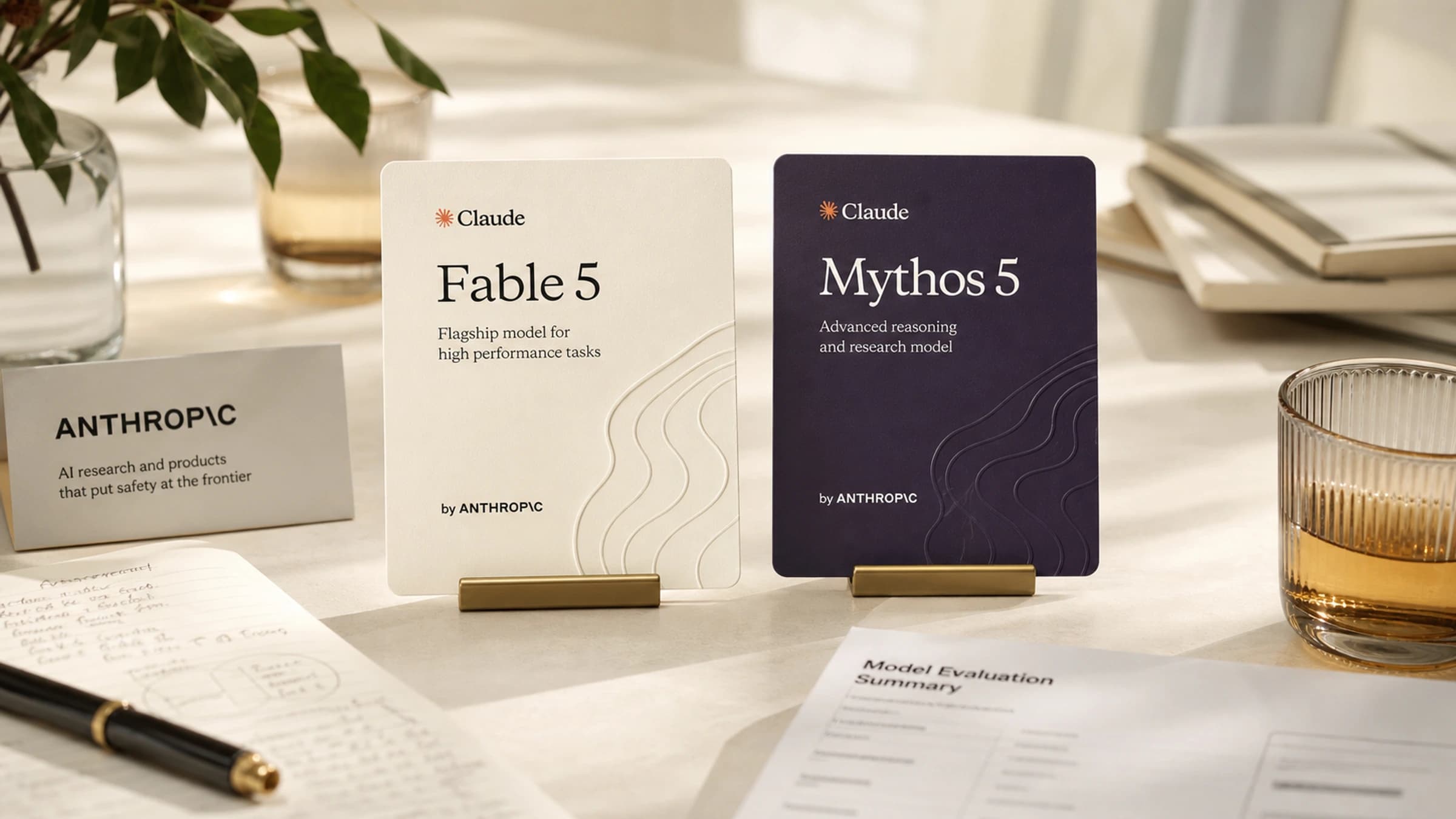
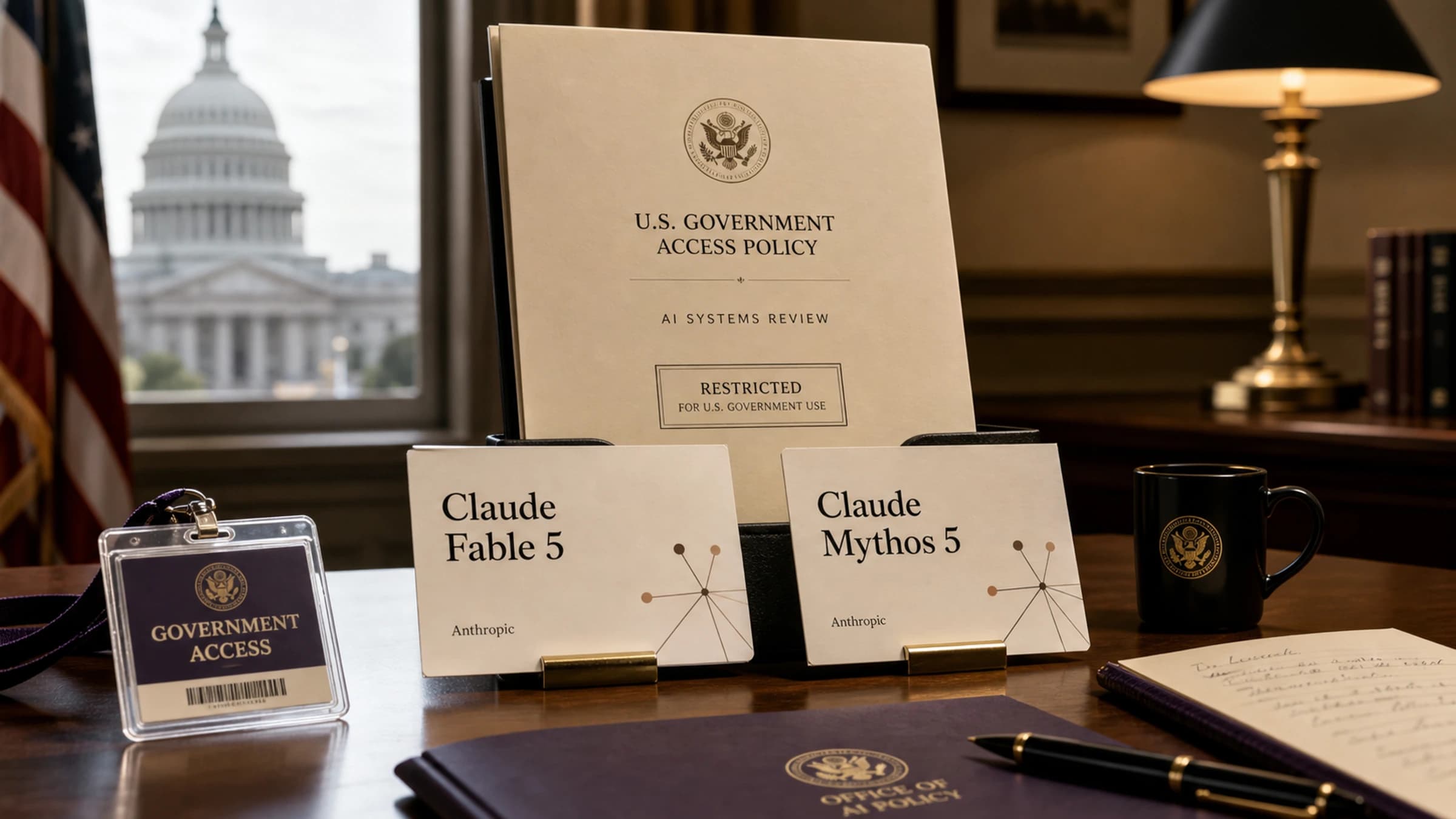
Anthropic launched Claude Fable 5 and Claude Mythos 5 into a regulatory fight that arrived almost immediately. On 9 June 2026, the company presented Fable 5 as a Mythos-class model safe enough for general use. Three days later, it said a US government export control directive forced it to remove access to both Fable 5 and Mythos 5 for all customers.
That last detail matters. The directive, according to Anthropic, targeted access by foreign nationals, including foreign national Anthropic employees, whether they were inside or outside the United States. But the practical result was broader: Anthropic said it had to disable Fable 5 and Mythos 5 for everyone to stay compliant.
I would not describe this as a simple "the US banned Claude" story. It is narrower than that legally, but wider than that operationally. The government appears to have drawn a hard line around a specific level of dual-use model capability, and Anthropic decided the only workable short-term compliance move was to pull the models completely.
That is the part worth paying attention to.
The short version : Why was Claude Mythos and Fable 5 Banned by the US Government?
| Question | Answer |
|---|---|
| What happened? | Anthropic launched Claude Fable 5 and Claude Mythos 5 on 9 June, then suspended access on 12 June after a US export control directive. |
| Was every Claude model banned? | No. Anthropic said all other Anthropic models were unaffected. |
| What did the directive target? | Anthropic says it required suspension of Fable 5 and Mythos 5 access by foreign nationals, including foreign national Anthropic employees. |
| Why did Anthropic disable access for all customers? | Anthropic said the order's practical effect forced it to disable the two models for all users to ensure compliance. |
| What reason did the government give? | Anthropic says the letter cited national security authorities but did not give specific details. Anthropic believes the concern related to a possible Fable 5 jailbreak. |
| What is Anthropic's position? | Anthropic says it is complying, but disagrees that the reported narrow jailbreak finding justifies recalling a commercial model. |
| Why should builders care? | This is a real test of frontier model release policy, export controls, enterprise data retention, and whether "safe general release" survives contact with government intervention. |
What launched first
The release itself was already unusual.
Anthropic positioned Claude Fable 5 as a Mythos-class model made safe for general use. It said Fable 5 was the same underlying model as Claude Mythos 5, but with extra safeguards that route risky cybersecurity, biology, chemistry, and distillation requests to Claude Opus 4.8 instead.
Mythos 5 was the more restricted sibling. It was meant for a small set of vetted partners, including Project Glasswing cyberdefence organisations, with some safeguards lifted for trusted use cases. Anthropic said Mythos 5 would be deployed in collaboration with the US government and would support cybersecurity and biology research.
That product split was the whole pitch:
| Model | Intended audience at launch | What made it different | Risk controls described by Anthropic |
|---|---|---|---|
| Claude Fable 5 | General users, enterprise customers, paid subscribers, API customers | Mythos-class model for long-running coding, knowledge work, vision, agents, and research-style tasks | Safeguards for cyber, biology, chemistry, and distillation. Flagged requests fall back to Opus 4.8. |
| Claude Mythos 5 | Project Glasswing partners, vetted cyberdefenders, infrastructure providers, and selected biology researchers | Same underlying model with safeguards lifted in some high-risk domains | Restricted access, trusted partner programme, 30-day retention, government-collaborative rollout. |
| Claude Opus 4.8 | Broadly available fallback model | Next-most-capable generally available model below Fable/Mythos | Used as the safer response path when Fable safeguards trigger. |
Anthropic also attached real commercial terms to the release. Fable 5 and Mythos 5 were priced at $10 per million input tokens and $50 per million output tokens. US-only inference was listed at 1.1x pricing. Using Mythos-class models required a 30-day data retention policy for safety monitoring, even on surfaces where customers may have been used to tighter retention terms.
That is not just a model launch. It is a new release model for dangerous capability: one public version, one trusted-access version, retention as a safety tool, and model routing as the compromise.
Then the compromise broke within three days.
The timeline of events leading up to the Claude Mythos and Fable 5 bans
| Date | Event | Why it matters |
|---|---|---|
| 7 April 2026 | Anthropic published the Claude Mythos Preview system card and said the model would not be generally available. | Mythos was already being treated as a capability jump that needed restricted deployment. |
| 22 May 2026 | Anthropic said Project Glasswing partners had used Mythos Preview to find more than 10,000 high or critical severity vulnerabilities. | This framed Mythos as a cyberdefence tool, not just a general chatbot. |
| 2 June 2026 | Anthropic expanded Project Glasswing to about 150 organisations in more than fifteen countries. | Access was widening, but still inside a trusted programme. |
| 9 June 2026 | Anthropic launched Claude Fable 5 and Claude Mythos 5. | Fable was the public Mythos-class release. Mythos 5 was the trusted-access version. |
| 9 June 2026 | AWS announced Claude Fable 5 availability through Amazon Bedrock and Claude Platform on AWS. | The model was not just on Anthropic's own app. It reached major cloud distribution. |
| 12 June 2026, 5:21pm ET | Anthropic says it received the US government directive. | This is the moment Anthropic says the compliance problem arrived. |
| 12 June 2026 | Anthropic said it was suspending Fable 5 and Mythos 5 access. | The operational result was a full access pull for both models. |
The speed is the story. Anthropic went from "safe enough for general use" to "unavailable for all customers" in three days.
What the US government directive actually did
Anthropic's statement says the US government, citing national security authorities, issued an export control directive to suspend access to Fable 5 and Mythos 5 by any foreign national. That included foreign nationals inside the US, foreign nationals outside the US, and foreign national Anthropic employees.
That is an export-control framing, not a consumer-safety takedown notice. The distinction matters because it treats access to the model as a controlled transfer of capability.
The awkward bit is implementation. Anthropic said the directive's net effect was that it had to abruptly disable Fable 5 and Mythos 5 for all customers. AWS said Anthropic asked it to revoke access to both models for all users to support compliance with the US government export control directive.
So the practical result looks like a ban. The legal mechanism appears more specific.
| Layer | What appears to be true from the available sources | Confidence |
|---|---|---|
| Legal trigger | Anthropic says it received an export control directive from the US government. | High, sourced to Anthropic and AWS. |
| Stated government concern | Anthropic says the letter cited national security authorities, but did not provide specific details. | High for Anthropic's account. Unknown for the government's full reasoning. |
| Targeted access | Anthropic says the directive suspended access by any foreign national. | High, sourced to Anthropic. |
| Operational effect | Anthropic and AWS say access was removed for all users. | High. |
| Public government document | I did not find a public Commerce or BIS notice during extraction. | Medium. This may change if the directive is later published. |
| Technical basis | Anthropic believes the concern was a potential Fable 5 jailbreak. | Medium. It is Anthropic's interpretation, not a full government explanation. |
This is where some headlines get too blunt. "Banned by the US government" is understandable as shorthand, because users lost access. But the more accurate version is: the US government issued an export control directive that Anthropic says forced a full customer access suspension.
The jailbreak dispute
Anthropic says the government did not give it specific details of the national security concern in the directive letter. Its understanding is that the government had become aware of a method for bypassing, or jailbreaking, Fable 5.
Anthropic's response is pointed. It says it reviewed a demonstration of the technique being used to identify a small number of previously known, minor vulnerabilities. It says those vulnerabilities appeared relatively simple and that other publicly available models could discover them without needing the same bypass.
That does not mean the government was wrong. We have not seen the full government case. It does mean the public record is lopsided: Anthropic has published its version, while the government reasoning is not yet visible in detail.
The dispute seems to be about thresholds.
| Question | Anthropic's public position | The unresolved policy question |
|---|---|---|
| Can Fable 5 be jailbroken at all? | Anthropic says no tester found a universal jailbreak, but narrow non-universal jailbreaks are likely possible for any provider. | Should a narrow jailbreak be enough to trigger a recall when the model is more capable than prior releases? |
| Did the reported bypass produce unique danger? | Anthropic says the demo involved minor, known vulnerabilities that other public models could find. | Does the government have stronger evidence that has not been published? |
| Were Fable's safeguards tested? | Anthropic says it worked with the US government, UK AISI, third parties, and internal teams for thousands of hours. | What level of pre-release testing should be required before general access? |
| Is 30-day retention part of the safety case? | Anthropic says retention helps detect and mitigate complex attacks, including jailbreaks. | Will enterprise customers accept frontier models that require more monitoring and less privacy flexibility? |
| Who should decide when a model ships? | Anthropic says government should be able to block unsafe deployments, but through a transparent, fair statutory process. | The current process looks opaque from the outside. |
My read: this is not really about one prompt trick. It is about whether a model with strong cyber and bio capability can be released publicly if its safety case depends on classifiers, monitoring, and fallback routing.
That is a much bigger fight.
Why Fable 5 was always a risky compromise
Fable 5 was Anthropic's attempt to square a hard circle.
On one side, Anthropic wanted to ship a model it described as stronger than anything it had previously made generally available. It talked about days-long asynchronous tasks, coding agents that can plan and check their own work, vision-heavy document analysis, long-context memory, scientific research and autonomous tool use.
On the other side, it knew Mythos-level capability creates obvious dual-use risk. Anthropic's own launch material says Fable 5's capabilities in cybersecurity could be misused to cause serious damage without safeguards. Its Mythos page says Mythos 5 is highly capable for cybersecurity and biology research, and could be used for good or harm.
The compromise was a safety wrapper:
| Safety mechanism | How Anthropic described it | Practical trade-off |
|---|---|---|
| Domain classifiers | Detect cyber, biology, chemistry, and distillation-related requests. | Classifiers can false positive, false negative, or become a target for jailbreak work. |
| Opus 4.8 fallback | Risky requests are answered by Opus 4.8 instead of Fable 5. | Users may not get the model they selected, but should not pay Fable prices for rerouted requests. |
| 30-day retention | Retain Mythos-class traffic for safety monitoring and attack research. | Better incident response, weaker privacy posture for some enterprise buyers. |
| Trusted access | Give less-restricted Mythos 5 only to vetted partners. | Useful for defenders, but it creates a gatekeeping and export-control problem. |
| Conservative rollout | Fable safeguards were tuned cautiously and could catch harmless requests. | Safer release, more frustrated users, more pressure to loosen controls. |
This was probably the only way Anthropic could justify a public Mythos-class model. It is also exactly why the release was fragile. If the government did not trust the wrapper, or thought the wrapper had already been bypassed in a meaningful way, the whole public-access story became shaky.
What this means for Anthropic
This is commercially painful, but the reputational effect is complicated.
On one hand, Anthropic launched a flagship model and lost access within days. Customers who planned around Fable 5 now have to fall back to Opus 4.8 or another model. AWS customers also saw access revoked. That is messy, especially for enterprise buyers who hate surprise platform changes.
On the other hand, Anthropic has been warning for months that frontier AI needs stronger release controls and even a government "brake pedal". This incident gives it a live example, although probably not the neat one it wanted. Anthropic is complying with the directive while arguing that the basis appears too thin and the process too opaque.
That is a hard position to hold, but it is not incoherent. You can believe government should be able to stop unsafe deployments and still object when the process feels rushed or technically under-explained.
| Anthropic problem | Why it matters |
|---|---|
| Product trust | A model that disappears after three days makes buyers nervous, even if the cause is government action. |
| Policy credibility | Anthropic has argued for stronger oversight. Now it is experiencing what that oversight can look like in practice. |
| Enterprise privacy | The 30-day retention requirement was already a customer trade-off before the suspension. |
| Cloud partner reliability | AWS had to revoke access after announcing availability, showing that third-party distribution does not avoid frontier model controls. |
| Competitive positioning | If other models can perform similar cyber tasks, Anthropic will argue the directive singled it out without reducing the broader risk. |
The line that stands out to me is Anthropic saying the demonstrated capability is widely available from other models, including OpenAI's GPT-5.5. That is a direct challenge to the logic of targeting one provider's model. If the government is worried about the capability class, it may need a capability-class policy, not a model-by-model scramble.
What this means for developers and enterprise teams
If you were planning to build on Fable 5, the immediate advice is boring but necessary: do not assume access will return on your preferred timeline.
Use Opus 4.8 or another available model for production workflows. Keep abstraction layers clean. Avoid hard-coding model behaviour where your product depends on a frontier model staying available. And if your workflow touches cybersecurity, biology, chemistry, vulnerability research, critical infrastructure, or model distillation, expect more compliance friction, not less.
| If you are... | Do this now |
|---|---|
| A developer using the Claude API | Check whether calls to claude-fable-5 fail or route elsewhere, then set an explicit fallback path. |
| An AWS Bedrock customer | Treat the AWS notice as authoritative for Bedrock availability and plan around revoked access. |
| A startup building agents | Do not build a product that only works with one frontier model ID. Add provider and model fallback. |
| A security team | Watch the trusted access programme. Mythos-class models may return first through vetted defensive channels. |
| A compliance lead | Review whether model access by nationality, employee location, or data residency can affect your AI procurement. |
| An enterprise buyer | Ask vendors what happens when a model is pulled by directive, not just when an outage occurs. |
The deeper lesson is that frontier model procurement now has a political layer. We are used to thinking about model risk as hallucinations, price, latency, privacy and uptime. Add access legality to the list.
The awkward precedent
This may be the first time many builders see a frontier model treated less like a SaaS feature and more like a controlled strategic capability.
That is not surprising. A model that can find vulnerabilities, assist bio research, run long-horizon agents and generalise across tools is not just another chatbot tier. Governments were always going to care once the capability crossed from "answers questions" into "can help execute difficult dual-use work".
Still, the precedent is awkward.
If the US government can force suspension based on a non-public technical concern, model companies will ask for clearer rules. If the government waits for perfect public rulemaking, dangerous models may ship faster than policy can react. If companies self-regulate, critics will say they are marking their own homework. If they do not ship, competitors may.
None of those options is clean.
The sensible path is probably boring: a published statutory process, technical disclosure rules, model-class thresholds, emergency powers with review, and a way for trusted defensive users to keep operating under supervision. Anthropic is effectively asking for that. The question is whether the US government is ready to formalise it, or whether the next few releases will be governed by private letters and emergency product pulls.
What I would watch next
| Signal to watch | Why it matters |
|---|---|
| A public BIS, Commerce, or White House explanation | This would clarify the legal authority, technical threshold, and whether the directive applies beyond Anthropic. |
| Anthropic restoring access to US-only users | That would suggest the issue is implementation and export compliance, not a permanent model ban. |
| A trusted access licensing process | This would show how Mythos-class capabilities can return for cyberdefenders and researchers. |
| Changes to AWS, Vertex AI, or other cloud model catalogues | Cloud availability will reveal how platform partners handle controlled frontier models. |
| Updated system cards or risk reports | Anthropic may need to publish more detail about Fable safeguards and the jailbreak dispute. |
| Similar restrictions on rival models | If the capability is widespread, policy pressure should not stop at Fable and Mythos. |
The bottom line
The clean version of the story is: Anthropic released Claude Fable 5 and Claude Mythos 5, then the US government banned them.
The more useful version is messier. Anthropic released a public Mythos-class model with safeguards, plus a restricted version for trusted partners. Three days later, it said a US export control directive aimed at foreign national access forced it to pull both models for all customers. The government concern appears to involve a potential Fable 5 jailbreak, but the detailed evidence has not been made public.
I do not think this is the end of Mythos-class models. I think it is the start of a new release pattern: more gated access, more retention, more government involvement, more cloud-partner caveats, and more fights over whether a model is dangerous because of what it can do, or because of who can access it.
For builders, the lesson is simple enough. Treat the frontier as unstable. Not because the models are bad, but because the policy layer has finally caught up with the capability layer, and it is not going to be tidy.

About the author
Hi, I'm Jason Futrill.
I'm an tech professional and commentator exploring how intelligent systems are reshaping work, creativity, and society.
More about me