Open source AI and closed AI models are two different ways of building, releasing, and controlling artificial intelligence. The choice affects what you can inspect, where the model runs, how much it costs, who handles safety, and how dependent your business becomes on a vendor.
The confusing part is that "open" can mean several things. Some models are truly open source under a strict definition. Some are open-weight models, where the trained parameters are available but the full training process is not. Others are fully proprietary systems available only through an app or API. This guide explains the difference in plain English and gives you a practical way to think about transparency, cost, safety, and business control.
Quick Answer: What Is Open Source AI vs Closed AI Models?
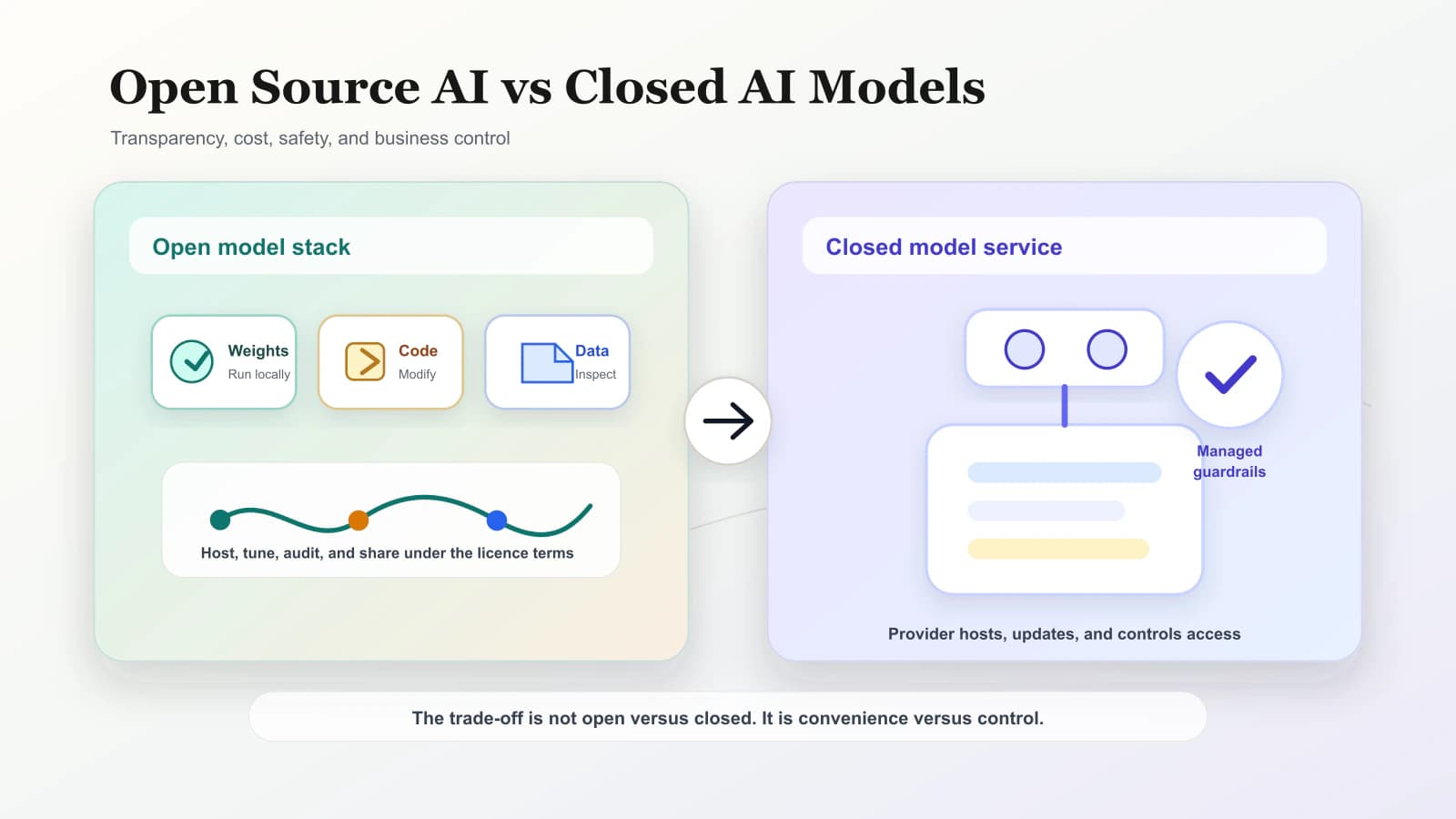
Open source AI gives users meaningful rights and access to use, study, modify, and share an AI system, including key parts such as code, data information, and model parameters. Closed AI models are proprietary systems where the provider controls the model, infrastructure, updates, and access, usually through a hosted product or API.
Open source AI vs closed AI models explained in simple terms
Think of an AI model like a specialised kitchen.
With a closed AI model, you order from the restaurant. The food may be excellent, the service may be fast, and you do not have to maintain the kitchen. But you cannot inspect every ingredient, change the recipe, move the kitchen into your own building, or keep cooking if the restaurant changes its menu, prices, or opening hours.
With open source AI, you get much more of the recipe, equipment list, and permission to run your own kitchen. Depending on how open the release really is, you may be able to inspect the model, adapt it, host it yourself, fine-tune it, and share improvements.
The trade-off is responsibility. Running your own kitchen means hiring people who know food safety, maintenance, storage, and quality control. Running your own AI stack means handling infrastructure, security, evaluations, compliance, monitoring, and updates.
The middle ground is open weights. In that case, you may get the trained model weights, which are the learned parameters that make the model behave the way it does. That is useful, but it is not always the same as full open source AI. You may still lack the complete training code, data information, tooling, or licence freedom needed to fully inspect and reproduce the system.
How open source AI and closed AI models work
The practical difference is not only whether you can download something. It is how much of the AI system you can control.
- Access: Open source AI gives users access to important system components and legal permission to use, study, modify, and share them. Closed AI models usually expose a product interface or API while keeping model weights, training data, and training methods private.
- Deployment: Open models can often be run on your own infrastructure, private cloud, edge devices, or a managed hosting platform. Closed models normally run on the provider's infrastructure.
- Updates: Open model users decide when to update, fine-tune, patch, or swap a model. Closed model users usually receive whatever model versions, retirements, and policy changes the provider offers.
- Data path: Self-hosted open models can keep prompts, files, and outputs inside your own environment. Closed models send requests to a provider, so data handling depends on the provider's policies, contract, and technical controls.
- Customisation: Open models can often be adapted more deeply, including fine-tuning, system-level changes, retrieval design, and specialist deployment. Closed models may offer fine-tuning or configuration, but inside vendor-defined limits.
- Accountability: Open systems make more of the stack inspectable, but the user owns more of the risk. Closed systems can provide support, abuse controls, and managed security, but the user has less direct visibility.
That is why "open or closed" is really a control question. The more control you take, the more operational responsibility you inherit.
Why open source AI vs closed AI models matters
This choice matters because AI is becoming infrastructure, not just a novelty interface.
For a casual user, the difference may be invisible. You ask a chatbot a question and get an answer. For a business, the model choice can affect product reliability, customer data handling, compliance, procurement, costs, intellectual property, and long-term flexibility.
The main reasons it matters are:
- Transparency: Can your team inspect how the system is built, what artefacts are available, and what limits are known?
- Cost: Are you paying a vendor per use, subscription, or contract, or are you paying for your own hosting, engineering, evaluation, and maintenance?
- Safety: Who tests the model, controls misuse, monitors incidents, and decides what guardrails apply?
- Business control: Can you move providers, run privately, customise deeply, or keep operating if a vendor changes direction?
- Speed: Can you start quickly with a hosted model, or do you need the flexibility of owning more of the stack?
Neither option is automatically better. A small team may get more value from a reliable proprietary API than from running its own model poorly. A regulated company may need the control and auditability of an open or self-hosted approach. The right answer depends on the job.
Key parts of model openness and control
When someone says a model is "open", ask what exactly is open.
| Part | What it means | Why it matters |
|---|---|---|
| Model weights | The learned parameters that shape model behaviour | Needed to run or adapt many models outside the original provider |
| Training code | The code used to train, process data, evaluate, and run the model | Helps others inspect, reproduce, modify, and improve the system |
| Data information | Details about what data was used, where it came from, and how it was processed | Supports transparency, bias review, provenance, and accountability |
| Licence terms | The legal permissions and restrictions attached to the release | Determines whether commercial use, modification, redistribution, or certain use cases are allowed |
| Hosting | Where the model runs and who controls the infrastructure | Affects data residency, latency, uptime, scaling, and operating cost |
| Guardrails | Safety filters, usage policies, monitoring, and refusal behaviour | Shapes misuse prevention, reliability, and user experience |
| Support | Documentation, updates, incident handling, and vendor help | Matters when the model becomes business-critical |
The most important lesson: open weights are helpful, but weights alone do not answer every transparency or control question.
Open source AI vs open weights vs closed AI
The industry often uses these labels loosely, so a practical comparison helps.
| Model type | Best for | Key difference |
|---|---|---|
| Open source AI | Teams that need inspectability, modification rights, redistribution rights, and long-term control | Should provide the freedoms and preferred modification materials needed to use, study, modify, and share the system |
| Open weights | Teams that want to run or fine-tune a released model but do not need the full training pipeline | Provides model parameters, but may not include full training code, data information, or broad licence freedom |
| Closed AI model | Teams that want fast access, managed infrastructure, strong hosted capability, and provider support | The provider controls the model internals, hosting, updates, access rules, and usually the roadmap |
This is why a model can be "available" without being fully open. Download access is not the same thing as open source freedom.
AI model transparency: what you can inspect
Transparency is the biggest conceptual difference between open and closed AI.
With a truly open source AI system, external researchers, developers, auditors, and customers can inspect more of the system. They can examine code, documentation, data information, model cards, licence terms, benchmarks, and known limitations. That makes it easier to understand how the system was built and where problems might come from.
With a closed AI model, transparency depends on what the provider chooses to publish. A strong provider may release detailed system cards, safety evaluations, policy documents, and enterprise controls. But customers usually cannot inspect the model weights, training code, or full training data process.
That does not make closed models useless or untrustworthy. It means trust is mediated through vendor documentation, contracts, audits, certifications, reputation, and your own testing. You can still evaluate output quality, measure failure rates, and design safeguards around a closed model. You just cannot inspect the whole machine.
The practical question is: how much visibility does your use case require?
For a writing assistant, vendor documentation and testing may be enough. For high-risk decisions, regulated workflows, sensitive data, or core product infrastructure, you may need deeper visibility and stronger control.
AI model cost: what you pay for
Open source AI can look cheaper because there may be no per-token API bill or expensive proprietary licence. But the real cost depends on the whole system.
With closed AI models, costs are usually easier to start with. You pay for usage, seats, subscriptions, or an enterprise contract. The provider handles the model hosting, scaling, upgrades, and much of the infrastructure complexity. This can be excellent for prototypes and teams that want capability quickly.
With open models, the licence cost may be low or zero, but other costs move onto you. You may pay for GPUs or specialised hosting, inference optimisation, monitoring, security, evaluation, data pipelines, fine-tuning, and people who can maintain the stack. A badly operated open model can become more expensive than a well-chosen hosted model.
The better cost question is not "which one is cheaper?" It is:
- What volume will we run?
- How predictable is usage?
- Do we have infrastructure skills?
- Do we need private deployment?
- What happens if provider prices change?
- What does downtime or poor output quality cost us?
At small scale, closed models often win on convenience. At large or specialised scale, open models can become attractive because you can optimise the stack around your exact workload.
Safety: who can test and control the model
Safety is where the debate gets noisy.
Open models can be inspected, tested, adapted, and red-teamed by a wider community. That can surface weaknesses quickly and help developers build domain-specific safeguards. Openness also supports independent research, local adaptation, and public scrutiny.
But openness can also make capable systems easier to modify and deploy without strong controls. A model that can be downloaded, fine-tuned, and run privately can be used responsibly or irresponsibly. The release licence, community norms, model capability, and deployment context all matter.
Closed models give the provider more centralised control. The provider can monitor abuse, update safety systems, restrict access, apply usage policies, and patch models without every customer maintaining their own safety layer. That can be useful, especially for general-purpose public products.
The limitation is that customers must rely on the provider's safety process and disclosures. If the model changes, if refusal behaviour shifts, or if an incident occurs, the customer may have limited insight into why.
The sensible view is simple: safety is not a property of the label. It is a property of the model, use case, deployment, monitoring, and governance around it.
Business control: who decides what happens next
Business control is the part that becomes obvious only after a model is embedded into real workflows.
With closed AI models, you are buying speed and managed capability. You also accept dependency. The provider can change pricing, rate limits, model availability, moderation policies, terms of service, product features, or data-handling options. A good contract can reduce that risk, but it cannot make the vendor disappear from the equation.
With open source AI or open-weight models, you can reduce vendor dependency. You may be able to run the model in your own cloud, keep data inside a specific region, tune the model for your domain, build fallbacks, or move between hosting providers. You can also keep using a model version after a vendor or community moves on, assuming the licence allows it and you can maintain it.
That control can be strategically valuable. It can also be heavy. If your team does not have the skills to evaluate, secure, and operate the model, the freedom may sit unused.
For businesses, the decision is often a portfolio choice, not a religion. Use a strong closed model where capability and speed matter. Use open models where privacy, portability, customisation, cost control, or resilience matter. Build your application so you can switch when the balance changes.
Examples of open source AI and closed AI models
Different teams will make different choices for good reasons.
| Scenario | Better fit | Why |
|---|---|---|
| Early prototype for a new AI feature | Closed model | Fast setup, strong general capability, less infrastructure work |
| Internal document assistant for sensitive data | Open or private deployment | Better control over where data goes and how retrieval is handled |
| Customer support chatbot with strict uptime needs | Either, depending on team | Closed may simplify reliability; open may improve control and fallback planning |
| Domain-specific model for legal, medical, or technical language | Open or custom approach | More room for evaluation, fine-tuning, and private deployment |
| Consumer app needing frontier model quality | Closed model | Hosted providers may offer the strongest general-purpose capability first |
| High-volume repetitive classification or extraction | Open model | Cost optimisation and workload-specific tuning may matter more at scale |
The point is not to pick a side forever. The point is to match the model strategy to the risk, workload, and business need.
Benefits and limitations of open source AI vs closed AI models
| Area | Open source AI benefit | Closed AI model benefit | What to watch |
|---|---|---|---|
| Transparency | More inspectable components and clearer modification path | Provider may publish polished documentation, evaluations, and controls | Marketing language can blur open source, open weights, and proprietary access |
| Cost | Potentially lower marginal cost at scale and more optimisation options | Lower setup burden and simpler early budgeting | Open models still require hosting, people, monitoring, and maintenance |
| Safety | More independent review and local control over safeguards | Centralised guardrails, abuse monitoring, and provider updates | Neither option removes the need for testing and governance |
| Data control | Can run in private environments or specific regions | Enterprise providers may offer contractual data controls | Verify data retention, training use, logging, and subprocessors |
| Customisation | More freedom to fine-tune, adapt, and integrate deeply | Configuration and fine-tuning may be easier through managed tools | Deep customisation can increase complexity and support burden |
| Business resilience | Less dependent on one provider if operated well | Provider handles scaling, uptime, and upgrades | Closed models can create lock-in; open models can create operational debt |
The practical pattern is familiar from software infrastructure: convenience and control pull in different directions.
How to choose between open source AI and closed AI models
Use this checklist before choosing a model strategy.
- Use open source AI or open-weight models when control over deployment, data, customisation, or long-term portability matters more than convenience.
- Use closed AI models when you need strong capability quickly and the provider's terms, data controls, pricing, and reliability fit the use case.
- Be careful with open models when your team lacks infrastructure, security, evaluation, or compliance capability.
- Be careful with closed models when the workflow touches sensitive data, regulated decisions, high-volume cost exposure, or business-critical dependency.
- Ask what is actually open: weights, code, data information, licence rights, evaluation results, or only marketing language.
- Ask what happens if the model fails, changes, becomes expensive, or is withdrawn.
- Start with the smallest responsible deployment, then measure quality, latency, cost, safety, and operational burden.
A good AI architecture should leave room to change your mind. The model market moves quickly, and yesterday's sensible choice may not be tomorrow's best one.
Common misconceptions about open source and closed AI models
Misconception 1: Open source AI means free AI.
Open source AI may be free to access or use, but operating it is not free. Compute, storage, security, evaluation, monitoring, and engineering time all count.
Misconception 2: Open weights are the same as open source AI.
Open weights are useful, but weights alone are not the full system. A model may provide parameters without the training code, data information, or licence freedoms associated with Open Source AI.
Misconception 3: Closed models are always safer.
Closed providers can apply strong centralised controls, but safety still depends on the model, product design, monitoring, policy, and use case. Lack of visibility can also make some risks harder to understand.
Misconception 4: Open models are always riskier.
Open models can be misused, but openness can also support independent testing, domain-specific safeguards, and faster public discovery of weaknesses. The deployment context matters.
Misconception 5: Businesses must choose only one approach.
Many teams use both. A company might use a closed frontier model for complex reasoning and an open model for private extraction, high-volume workflows, or fallback capacity.
What to remember about open source AI vs closed AI models
- Open source AI is about rights and access: use, study, modify, and share, with enough system material to make those freedoms meaningful.
- Closed AI models are proprietary systems where the provider controls the model internals, infrastructure, updates, access, and often safety policies.
- Open weights are a useful middle ground, but they are not automatically the same as full open source AI.
- Open models can improve transparency, customisation, private deployment, and portability, but they add operational responsibility.
- Closed models can offer speed, strong hosted capability, support, and managed safety controls, but they increase vendor dependency.
- The best choice depends on your workload, data sensitivity, risk level, budget, team skills, and need for control.
FAQ about open source AI vs closed AI models
What is the main difference between open source AI and closed AI models?
The main difference is control. Open source AI gives users more rights and access to inspect, modify, run, and share the system. Closed AI models keep the core model proprietary and usually provide access through an app or API controlled by the provider.
Are open weights the same as open source AI?
No. Open weights mean the trained model parameters are available. Open source AI is broader. It should include meaningful access and rights around the system, including code, data information, parameters, and licence terms that allow use, study, modification, and sharing.
Are open source AI models cheaper than closed AI models?
Not always. Open models may avoid some vendor usage fees, but you still pay for infrastructure, optimisation, monitoring, evaluation, security, and skilled people. Closed models often cost more per use at scale, but they can be cheaper to start because the provider runs the stack.
Are closed AI models safer than open models?
Closed models can have centralised guardrails, monitoring, and provider updates, but that does not make them automatically safer. Open models can benefit from independent testing and local controls. Safety depends on the model, deployment, policies, monitoring, and use case.
Why do businesses use closed AI models?
Businesses use closed AI models because they are often fast to adopt, powerful, well documented, and managed by the provider. Teams can avoid running model infrastructure themselves and can rely on provider support, scaling, updates, and enterprise controls when the terms fit.
Why do businesses use open source AI or open-weight models?
Businesses use open models when they need more control over data, deployment, customisation, cost optimisation, or vendor independence. Open models are especially attractive when a team has the skills to evaluate, secure, host, and maintain the system responsibly.
Can a company use both open and closed AI models?
Yes. Many sensible AI strategies use both. A company might use a closed model for high-quality general reasoning and an open model for private workloads, cost-sensitive inference, fallback capacity, or specialist tasks. The best architecture keeps options open.

About the author
Hi, I'm Jason Futrill.
I'm an tech professional and commentator exploring how intelligent systems are reshaping work, creativity, and society.
More about me