
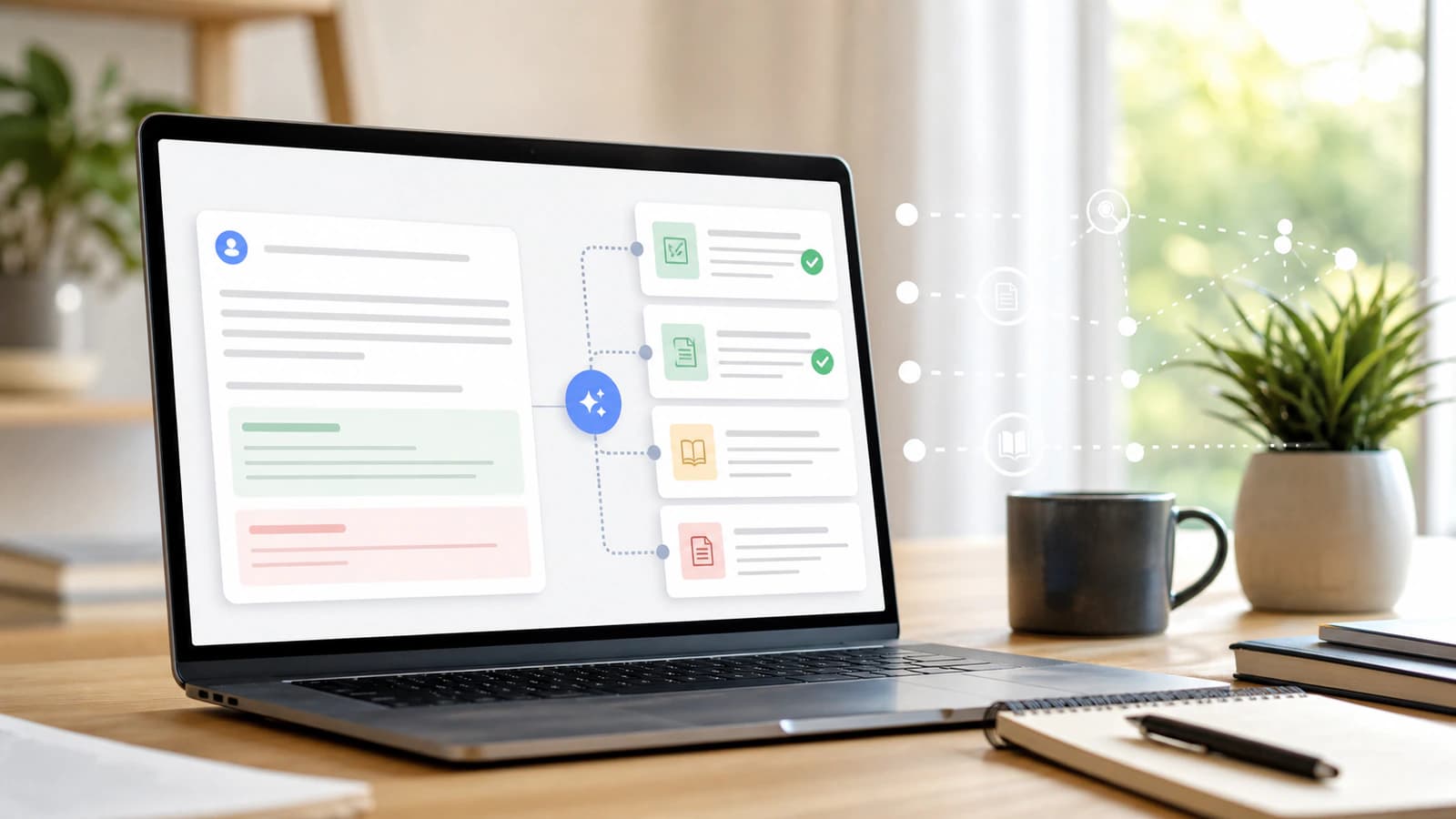
Why does AI hallucinate? Because most generative AI systems are built to produce likely answers, not to guarantee truth. That distinction matters. A chatbot can sound calm, specific, and authoritative while inventing a citation, mixing up a date, misreading a document, or giving an answer that has no solid source behind it.
AI hallucinations are not just funny mistakes. In low-stakes brainstorming they may be harmless. In research, legal work, medicine, finance, business operations, and public communication, a false AI answer can mislead people quickly. This explainer defines AI hallucinations, explains why they happen, and gives practical ways to reduce the risk without pretending it can be removed completely.
Quick Answer: What Are AI Hallucinations?
AI hallucinations are false or unsupported outputs produced by a generative AI system, often with confident wording. They can include invented facts, fake citations, incorrect summaries, flawed reasoning, or claims that do not match the source material. They happen because AI models generate plausible patterns, and plausibility is not the same as truth.
AI Hallucinations Explained in Simple Terms
An AI hallucination is a polished answer that looks right but is wrong, unsupported, or inconsistent with the evidence.
The word "hallucination" is imperfect because the model is not seeing or believing anything. It is generating text, code, images, or other outputs based on patterns it has learned. Still, the term is useful because the result can feel like a false perception: the system presents something that is not there.
Think of an AI model as an extremely fluent autocomplete system with broad training and some reasoning ability. If it has the right information and the task is clear, it can be very useful. If the information is missing, ambiguous, stale, or hard to verify, it may still produce an answer that sounds complete.
That is the danger. The surface quality of the answer can be much stronger than the factual quality underneath.
How AI Hallucinations Happen
AI hallucinations usually come from several causes working together, not one simple bug.
- Pattern prediction: Large language models predict likely next words or tokens. They learn statistical patterns in language, but those patterns do not automatically include a truth-checking mechanism.
- Missing or weak information: If the model lacks reliable information about a fact, person, product, policy, or date, it may fill the gap with a plausible guess.
- Ambiguous prompts: Vague questions invite the model to infer the task, context, audience, and standard of proof. Some of those inferences will be wrong.
- Training and evaluation incentives: If systems are rewarded mainly for giving answers, they can learn to guess instead of admitting uncertainty.
- Context limits: A model can only use the information available in its context window, connected tools, retrieval system, or training. Important details outside that context may be missed.
- Retrieval or tool errors: Search, retrieval-augmented generation, database lookups, and tool calls can reduce hallucinations, but only if the right sources are retrieved and used correctly.
- Overconfident language: Models often write in fluent, decisive prose even when the underlying answer is uncertain. Confidence in tone is not evidence.
In practice, hallucinations are most common when a task asks for specific facts, rare details, fresh information, citations, calculations, legal references, medical guidance, or summaries of material the model has not actually seen.
Why AI Hallucinations Matter
AI hallucinations matter because they create a trust gap. People often judge answers by how readable and confident they sound. Generative AI makes that shortcut risky.
The impact depends on the task:
- In writing, a hallucination can insert a false claim into otherwise good copy.
- In research, it can send a reader towards sources that do not exist.
- In customer support, it can promise refunds, features, or policies the business does not offer.
- In coding, it can invent library methods, configuration options, or security assumptions.
- In legal, financial, medical, and compliance work, it can become a serious professional risk.
The practical lesson is not "never use AI." It is "match your verification process to the stakes." A brainstorming error is annoying. A false compliance answer can be expensive.
Common Types of AI Hallucinations
| Type | What it looks like | Why it is risky |
|---|---|---|
| Factual fabrication | The model invents a date, name, statistic, feature, event, or policy | False details can be copied into decisions, articles, reports, or customer messages |
| Fake citation | The model provides a source, case, paper, URL, or quotation that does not exist or does not support the claim | Citations create a false sense of auditability |
| Source mismatch | The answer cites a real source but attributes the wrong claim to it | Readers may trust the answer because the source looks legitimate |
| Summary drift | A summary adds details, changes emphasis, or overstates what the original document says | This can distort contracts, policies, research, or meeting notes |
| Reasoning error | The model follows a plausible chain of logic to a wrong conclusion | The explanation can make the wrong answer feel more credible |
| Stale answer | The model gives outdated product, legal, pricing, or availability information | Time-sensitive answers can become wrong even if they were once true |
| Tool-use mistake | The system retrieves the wrong document, misreads a table, or ignores a tool result | Grounding helps only when the workflow is designed and checked well |
This is why "ask for sources" is helpful but not enough. The source itself has to be real, relevant, current, and correctly interpreted.
Real-World Examples of AI Hallucinations
AI hallucinations show up in ordinary work, not only in dramatic failure stories.
A student asks for a reading list and receives several invented academic papers. The titles sound plausible because they resemble real scholarship, but the papers are not real.
A marketer asks for competitor pricing and receives a confident comparison based on old information, guessed plan names, or mixed-up product tiers.
A lawyer asks for supporting cases and receives citations that look formal but do not exist. This is one of the clearest examples of why high-stakes work needs source verification outside the model.
A manager uploads a policy document and asks for a summary. The AI correctly summarises most of it, then adds an exception that is not in the policy.
A developer asks how to use a library and gets an answer with a method name that sounds consistent with the library's style but is not actually available.
The common thread is not stupidity. It is plausibility. The answer feels like the kind of answer that should exist.
How to Reduce AI Hallucinations
You cannot eliminate AI hallucinations completely, but you can reduce their frequency and limit the damage. The best approach is layered: better prompts, better context, grounded sources, checks, and human judgement.
| Method | What to do | Best for | Limitation |
|---|---|---|---|
| Give trusted source material | Paste or attach the documents, data, or links the answer must use | Summaries, policy answers, research notes, internal knowledge | The model can still misread or overgeneralise the source |
| Restrict the answer to provided sources | Tell the model to answer only from supplied material and say when the answer is not present | Compliance, legal support, product policy, technical docs | The instruction must be tested, not just assumed |
| Require citations or quotes | Ask for each factual claim to be backed by a quote, page, section, URL, or source pointer | Auditable research and document Q&A | Citations can still be wrong unless checked |
| Ask for uncertainty | Allow the model to say "I do not know", ask clarifying questions, or list assumptions | Ambiguous or incomplete tasks | Some systems still over-answer unless prompted and evaluated well |
| Split generation from verification | Generate an answer, then separately check claims against sources | Articles, reports, analysis, customer-facing copy | Verification adds time and needs good source access |
| Use retrieval or grounding | Connect the system to current documents, search, databases, or knowledge bases | Fresh or organisation-specific information | Retrieval can fetch the wrong source or miss the right one |
| Add human review for high-stakes work | Require a qualified person to approve claims before use | Legal, medical, financial, security, compliance, public communications | Human review must be meaningful, not a rubber stamp |
For everyday use, the simplest upgrade is this prompt:
Answer only from the information I provide. If the answer is not present, say "I do not know from the provided material." For every factual claim, include the exact source, section, quote, or evidence you used.That prompt will not make a model perfect, but it changes the job from "sound helpful" to "stay anchored".
A Practical AI Hallucination Risk Checklist
Use this quick checklist before relying on an AI answer:
- Is the answer based on material the model actually received or could access?
- Does it include specific facts, numbers, names, dates, legal references, prices, or claims that need checking?
- Are the citations real, reachable, and relevant to the claim?
- Is the topic current enough that model training data may be stale?
- Would a wrong answer cause reputational, financial, legal, health, or safety harm?
- Did the model clearly state uncertainty, assumptions, or gaps?
- Has a person with the right expertise reviewed the answer?
If the answer fails any of those checks, slow down. Use the output as a draft, not as a source of truth.
AI Hallucination vs Error vs Creative Output
People often call every AI mistake a hallucination, but the distinction helps.
| Concept | Best description | Example |
|---|---|---|
| AI hallucination | A false or unsupported output presented as if it were true | Inventing a journal article or misquoting a policy |
| Ordinary error | A mistake caused by poor reasoning, bad input, or a misunderstanding | Misclassifying a customer request after receiving confusing instructions |
| Creative fiction | An invented output that is expected and useful because the task is imaginative | Writing a fictional product story or concept scene |
| Stale information | An answer that may have been correct before but is no longer current | Naming an old product price or outdated feature limit |
| Bias or distortion | A skewed answer caused by data patterns, framing, or assumptions | Over-representing one perspective in a summary |
The same model behaviour can be useful or risky depending on the task. In fiction, invention is the point. In a board report, invention is a problem.
Common Misconceptions About AI Hallucinations
The first misconception is that better models will make hallucinations disappear. Better models can reduce hallucinations, especially when they are designed to express uncertainty, but no general-purpose system should be treated as infallible.
The second misconception is that confident answers are more likely to be true. Confidence is a writing style. It is not a proof signal.
The third misconception is that asking for citations solves the problem. Citations help only when they are real, relevant, and checked against the claim.
The fourth misconception is that hallucinations only happen when the model is "making things up from training data." Hallucinations can also happen when the system retrieves the wrong document, misreads a document, ignores a tool result, or overstates a weak source.
The fifth misconception is that hallucinations are always useless. In creative work, the same generative tendency can produce useful ideas. The problem begins when invented material is presented as factual.
How to Think About AI Hallucination Risk
The most useful mental model is simple: AI is a drafting and reasoning assistant, not an authority by default.
Use AI freely when the cost of being wrong is low, such as brainstorming, rewriting, outlining, role-playing objections, or generating options. Add checks when the answer affects decisions, money, reputation, customers, safety, law, health, or public claims.
The higher the stakes, the more the workflow should shift from "ask and accept" to "ask, ground, verify, and approve".
For teams, that means hallucination reduction is not just a prompt-writing problem. It is a product and process problem. Useful systems need source access, retrieval quality, evals, logging, clear refusal behaviour, citation design, and review paths for consequential outputs.
What Comes Next for AI Hallucination Reduction
The next stage of hallucination reduction is less about one perfect prompt and more about better systems. Models are being trained and evaluated to express uncertainty more appropriately. Products are adding grounding, citations, retrieval, browsing, tool use, and verification workflows. Organisations are building policies that define when AI output needs human review.
The direction is encouraging, but the standard should stay realistic. A model connected to sources can still retrieve the wrong thing. A citation can still be misapplied. A polished answer can still skip the caveat that matters.
The winning habit is not distrust. It is calibrated trust.
What to Remember About AI Hallucinations
- AI hallucinations are false or unsupported outputs that often sound confident and fluent.
- They happen because generative AI predicts plausible outputs, and plausible does not always mean true.
- Hallucinations are more likely with rare facts, current information, citations, calculations, high-context domains, and vague prompts.
- Grounding, retrieval, citations, uncertainty prompts, claim checks, and human review can reduce risk.
- Asking for sources helps, but sources must be checked for existence, relevance, freshness, and accuracy.
- The safest habit is to treat AI as a draft partner until important claims are verified.
FAQ About AI Hallucinations
Why does AI hallucinate?
AI hallucinates because generative models produce likely outputs based on patterns, context, and training, not guaranteed truth. If the model lacks reliable information or is rewarded for answering confidently, it may generate a plausible false answer instead of admitting uncertainty.
What is an example of an AI hallucination?
An AI hallucination could be a chatbot inventing a court case, academic paper, product feature, statistic, or quote. It may format the answer convincingly, but the underlying fact is false, unsupported, or not present in the source material.
Are AI hallucinations the same as lies?
No. A lie implies intent to deceive. A model does not have human intent. An AI hallucination is better understood as a false or unsupported output generated by a system that is optimised to produce plausible responses.
Can AI hallucinations be eliminated?
Not completely in normal real-world use. Better models, grounding, retrieval, citations, uncertainty training, and verification workflows can reduce hallucinations, but important AI outputs should still be checked against trusted sources, especially in high-stakes settings.
Does asking AI for sources prevent hallucinations?
Asking for sources can reduce risk, but it does not prevent hallucinations by itself. The model may cite a real source incorrectly or invent a citation. Always check whether the source exists, whether it is current, and whether it actually supports the claim.
Does RAG stop AI hallucinations?
Retrieval-augmented generation can reduce hallucinations by connecting a model to external documents or search results. It does not guarantee correctness. A RAG system can retrieve irrelevant material, miss the best source, or generate an answer that goes beyond the retrieved evidence.
How should businesses reduce hallucination risk?
Businesses should classify AI use cases by risk, ground answers in trusted sources, require citations for factual claims, test outputs with evaluations, log failures, and add human review for consequential decisions. The goal is not blind trust. It is controlled, auditable use.

About the author
Hi, I'm Jason Futrill.
I'm an tech professional and commentator exploring how intelligent systems are reshaping work, creativity, and society.
More about me