
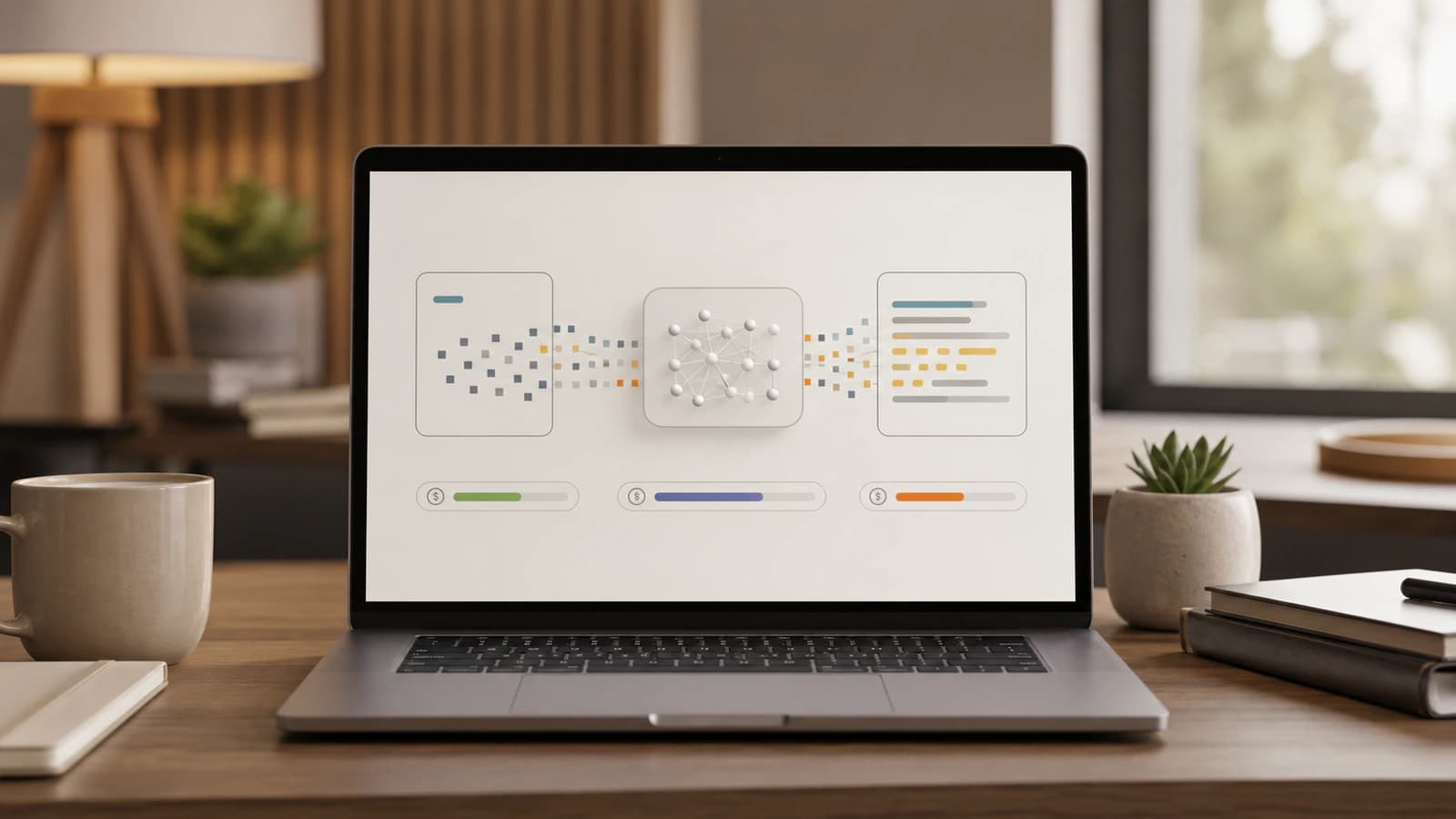
If you use ChatGPT, Copilot, Claude, Gemini, or an AI API, you will eventually run into the word "token." It appears in pricing pages, model limits, usage dashboards, developer docs, and warnings about context windows. It sounds technical, but the idea is simple: tokens are how AI systems break information into pieces they can process.
This guide explains what AI tokens are, why they are not the same as words, and how they affect three things every user notices eventually: cost, memory, and output length.
Quick Answer: What is a token in AI?
AI tokens are the small units of text or data that an AI model processes. A token can be a word, part of a word, punctuation, a space, or another data unit. Tokens matter because they determine how much context fits, how long outputs can be, and how usage is priced.
AI tokens explained in simple terms
An AI model does not read your prompt exactly the way you read a sentence. Before the model can work with your words, the text is broken into smaller pieces called tokens. The model then processes those tokens, predicts useful next tokens, and turns the result back into text you can read.
In English, a short common word might be one token. A longer word might split into several tokens. Punctuation, spaces, capitalization, and word fragments can also affect the count. This is why "AI tokens" are related to words, but not identical to words.
A rough rule of thumb for English is that one token is about four characters, or about three quarters of a word. That makes 100 tokens roughly 75 words. Treat that as a planning estimate, not a measurement. Exact counts depend on the model and tokenizer.
Outside text, the same idea can apply to other data. Some AI systems turn images, audio, video, or sensor data into token-like units so the model can process them. For most beginners, though, text tokens are the place to start.
How AI tokenization works
Tokenization is the process that turns your input into model-readable pieces. The exact method varies by model, but the basic flow looks like this:
- Start with input: You type a prompt, paste a document, send a chat history, or provide another input.
- Split into tokens: The system breaks that input into smaller units such as words, word parts, punctuation, spaces, or other data chunks.
- Assign token IDs: Each token is represented internally as a number the model can work with.
- Process relationships: The model analyzes how the tokens relate to one another within the available context.
- Generate output tokens: The model predicts and produces response tokens one after another.
- Convert back to text: The generated tokens are decoded into the words, sentences, code, or other output you see.
- Track usage: The platform records token usage for limits, billing, rate control, and usage reporting.
That last step is why tokens show up in pricing and dashboards. They are not just a language trick. They are also a usage meter.
Why AI tokens matter for pricing, memory and output length
Tokens matter because they sit underneath the user experience. When an AI answer feels too short, too expensive, too slow, or forgetful, token limits are often part of the story.
- Pricing: Many AI APIs and services price usage by token. The provider may count input tokens, output tokens, cached tokens, and sometimes reasoning tokens differently.
- Memory: The model can only process a limited number of tokens at once. That limit is the context window.
- Output length: The answer has to fit inside the same overall token budget as the prompt, conversation history, tool context, and uploaded text.
- Speed: AI applications often care about how quickly the first token appears and how quickly later tokens are generated.
- Model choice: Larger context windows and more capable models can handle more complex jobs, but they may have different cost and latency trade-offs.
This is the practical mental model: tokens are the budget. Your prompt spends some of it. Your documents spend some of it. The model's answer spends the rest.
Key parts of AI token usage
| Part | What it means | Why it matters |
|---|---|---|
| Input tokens | Prompt, files, instructions, examples, and chat history. | Define what the model receives and contribute to cost. |
| Output tokens | Tokens generated in the model's response. | Control answer length, cost, and response time. |
| Cached tokens | Previously used context processed more efficiently. | Can reduce cost or latency where supported. |
| Reasoning tokens | Internal tokens some advanced models use on hard tasks. | Can improve complex answers but increase usage. |
| Context window | Maximum combined token space the model can process. | Limits what input and output fit in one request. |
| Token limit | Cap on total, output, or per-minute tokens. | Controls request size, response length, and throughput. |
The important detail is that these categories are connected. If you fill the context window with a long prompt, you leave less room for the model's answer. If you ask for a long output, you need to reserve enough tokens for that output.
Real-world examples of AI tokens
In a short chat, token counts are mostly invisible. You ask, "Write a friendly reminder email," and the model answers. The prompt and response may only use a few hundred tokens.
In a long document summary, tokens become more obvious. If you paste a 40-page report into a model, the report, your instructions, and the summary all need to fit within the model's token limit. If they do not, you may need to summarize sections first or split the report into chunks.
In a customer support chatbot, token management affects both cost and relevance. The system may need customer history, policy text, product details, and the current conversation. Too little context makes the answer generic. Too much irrelevant context wastes money and can crowd out what matters.
In an API workflow, tokens become a direct cost lever. A developer sending thousands of long prompts each day will pay more than someone sending compact prompts to the same model, all else being equal. Output length matters too, because generated tokens are also counted.
In translation or sentiment analysis, tokenization helps the model break text into manageable units. The model can then map meaning across languages or evaluate the tone of a review without treating the sentence as one indivisible block.
Benefits and limitations of token-based AI
| Area | Benefit | Limitation | What to watch |
|---|---|---|---|
| Cost control | Tokens make usage measurable. | Token counts can grow quietly in long chats or document-heavy workflows. | Track both input and output tokens, not just prompt length. |
| Context | A larger token window lets the model consider more material. | More context is not the same as perfect understanding. | Include the most relevant information, not every available scrap. |
| Output length | Token budgets let systems control maximum response size. | Long answers can hit limits or become expensive. | Reserve enough output tokens before asking for detailed work. |
| Speed | Token throughput helps developers reason about latency. | More tokens can mean slower responses. | Balance answer quality, cost, and speed for the task. |
| Prompt design | Token thinking encourages focused prompts. | Over-compression can remove details the model needs. | Cut filler, not useful context. |
The best token strategy is not always "use fewer tokens." The better goal is to spend tokens on the information that improves the answer.
AI tokens vs words, characters and context windows
People often confuse tokens with nearby concepts. The differences matter.
| Concept | Plain-English meaning | Key difference |
|---|---|---|
| Token | A model-readable unit of text or data. | It may be a word, word part, punctuation mark, space, character, or non-text unit. |
| Word | A human-readable unit of language. | Words are easier for people to count, but models usually process tokens. |
| Character | A single letter, number, symbol, or space. | Characters help estimate tokens, but they are not the same as tokens. |
| Context window | The model's available working space for tokens. | It is a limit on what can fit, not a guarantee the model will use every detail perfectly. |
| Memory | Stored or remembered information. | A context window is temporary working context. Product memory, when available, is a separate feature. |
Think of the context window as the model's desk for the current job. Tokens are the pages, sticky notes, and draft answer taking up space on that desk. A bigger desk helps, but a messy pile can still make the work harder.
How to manage your AI token budget
You do not need to count every token by hand. You do need to know when token budget matters.
- Put the most important context first, especially instructions, constraints, and the current task.
- Remove repeated boilerplate, old chat turns, and irrelevant source text.
- Summarize long histories before continuing a complex conversation.
- Split large documents into chunks when they exceed the model's context window.
- Reserve room for the answer if you need a long output, a detailed analysis, or structured code.
- Use an official tokenizer or model-specific counting tool when exact cost or limits matter.
- Choose larger-context models for long documents, not for every small task by default.
For everyday prompting, this means writing with intent. Say what the model should do, include the facts it needs, and avoid dragging along a suitcase full of text just because the model can technically accept it.
Common misconceptions about AI tokens
The first misconception is that one token equals one word. Sometimes it does. Often it does not. A token can be a word fragment, punctuation mark, or space-sensitive unit.
The second misconception is that a bigger context window means unlimited memory. It does not. It means more material can fit into the current request or conversation. The model still has to use that material effectively.
The third misconception is that only your prompt counts. The model's answer counts too. So can system instructions, retrieved documents, examples, prior conversation, cached context, and internal reasoning tokens in some models.
The fourth misconception is that shorter prompts are always better. A short vague prompt can produce a weak answer. A slightly longer prompt with clear constraints and relevant context can be cheaper in the end if it avoids rework.
The fifth misconception is that token counting is exact across all AI tools. It is not. Tokenization varies by model and encoding, so the same text can count differently in different systems.
What comes next for AI tokens
Tokens are becoming more important, not less. Models are handling longer context windows, more modalities, and more complex reasoning. That means token budgets now cover more than short chat prompts.
Multimodal systems can tokenize images, audio, video, and other data. Reasoning models may use extra internal tokens while solving a problem. High-volume AI services care deeply about cost per token, tokens per minute, time to first token, and the rate at which output tokens appear.
For users, the trend is straightforward: AI tools will keep feeling more capable, but smart context management will still matter. Bigger windows reduce friction. They do not remove the value of clear instructions and relevant inputs.
Jason's take on AI tokens
The most useful way to think about AI tokens is as attention budget.
Every token asks the model to spend a little processing capacity on something. Some tokens are doing real work: the user's goal, a key fact, a useful example, a constraint, a piece of source text. Other tokens are just taking up room.
That is where better AI use starts to look less like prompt magic and more like good editing. Put the right material in the window. Cut the noise. Leave enough room for the answer. Use larger context when the job actually needs it.
Tokens are technical under the hood, but the user lesson is beautifully ordinary: clarity still wins.
Key Takeaways
- AI tokens are small units of text or data that models process, not exact word counts.
- Token counts affect pricing, context windows, output length, latency, and usage limits.
- The context window is the combined space for input, conversation history, retrieved context, and output.
- Exact token counts vary by model and tokenizer, so use a counting tool when limits or cost matter.
- Good token management means spending tokens on relevant context and leaving enough room for the response.
FAQ about AI tokens
Are AI tokens the same as words?
No. AI tokens are not always words. A token can be a whole word, part of a word, punctuation, a space, or another unit of data. Words are a helpful human estimate, but models process tokens internally.
How many words is 1,000 AI tokens?
For English text, 1,000 tokens is roughly 750 words. That estimate comes from the common rule of thumb that one token is about three quarters of a word. Exact counts vary by model, tokenizer, language, punctuation, and formatting.
Why do AI tools charge for AI tokens?
AI tools often charge by token because tokens are a measurable unit of model work. The system processes input tokens and generates output tokens, and both can consume compute. Pricing can vary by model and by token category, so current provider pricing should be checked before budgeting.
What is a context window in AI?
A context window is the maximum amount of tokenized information a model can process at once. It usually includes your prompt, instructions, relevant conversation history, retrieved material, and the model's output. If the combined total is too large, content must be shortened, chunked, or summarized.
Can an AI remember more if it has more tokens?
A larger context window lets an AI model consider more information in the current interaction, but it is not the same as permanent memory. It is better to think of it as working space. Some products may add separate memory features, but context tokens still govern what fits in the active request.
How do I reduce AI token usage?
Reduce token usage by removing repeated text, summarizing old conversation history, chunking large documents, writing focused prompts, and asking for only the output you need. Do not cut useful context just to make the prompt shorter. The aim is better signal, not just fewer words.
Do images and audio use AI tokens too?
Some AI systems tokenize non-text inputs such as images, audio, video, or sensor data. The exact representation depends on the model and modality. For beginners, text tokens are the simplest starting point, but the broader idea is the same: models process information by converting it into manageable units.

About the author
Hi, I'm Jason Futrill.
I'm an tech professional and commentator exploring how intelligent systems are reshaping work, creativity, and society.
More about me