
AI vs machine learning vs deep learning vs generative AI is one of those phrases people search after hearing the terms used interchangeably in meetings, product pages, and headlines.
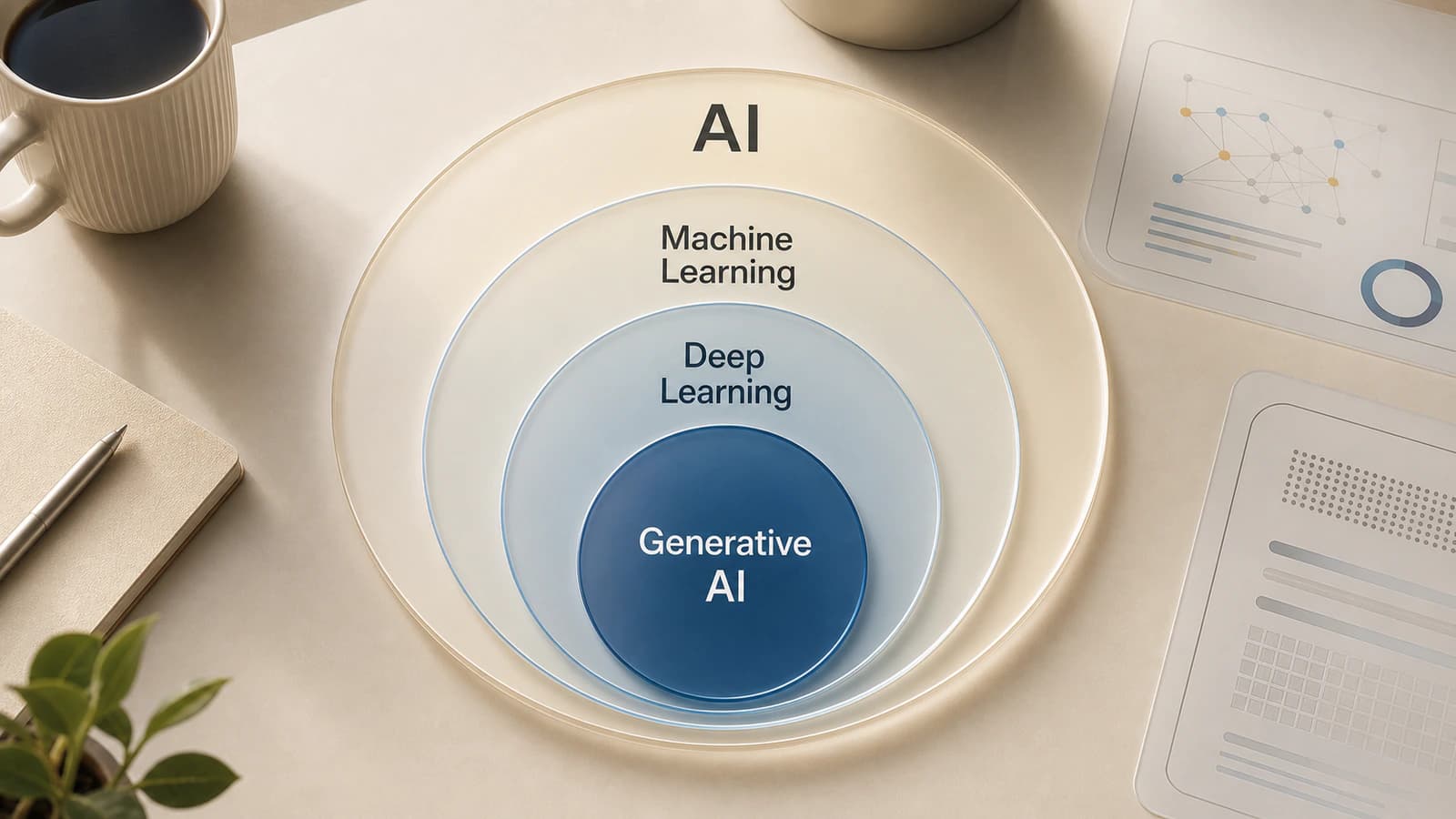
The confusion is understandable. These ideas are related, but they are not the same thing. AI is the broad umbrella. Machine learning is a major way to build AI systems. Deep learning is a more specialized kind of machine learning. Generative AI is a creation-focused type of AI that often uses deep learning and foundation models.
Once you see the hierarchy, the terminology gets much less slippery.
Quick Answer: What is AI vs machine learning vs deep learning vs generative AI?
AI vs machine learning vs deep learning vs generative AI is a hierarchy of related terms. Artificial intelligence is the broad field of systems that can perform tasks associated with intelligence. Machine learning is AI that learns patterns from data. Deep learning is machine learning using multi-layer neural networks. Generative AI creates new content such as text, images, audio, video, or code.
AI vs machine learning vs deep learning vs generative AI explained in simple terms
Think of these terms as a family tree, not a menu of rival technologies.
Artificial intelligence is the broadest category. It includes systems that make predictions, recommendations, classifications, plans, or decisions. Some AI systems are built with rules. Some are built with machine learning. Some combine several techniques.
Machine learning sits inside AI. Instead of being programmed only with fixed instructions, a machine learning system learns patterns from examples. A spam filter, fraud detector, recommendation engine, or demand forecast can all use machine learning.
Deep learning sits inside machine learning. It uses neural networks with multiple layers to learn complex patterns from large amounts of data. Deep learning is especially useful for language, images, audio, video, and other messy data where simple rules do not stretch very far.
Generative AI is a type of AI focused on producing new outputs. It can write text, generate images, draft code, summarize documents, compose audio, or create video. Many modern generative AI systems use deep learning and foundation models, but the defining feature is the output: they generate content.
The AI hierarchy at a glance
| Term | Place in the hierarchy | What it means | Simple example |
|---|---|---|---|
| Artificial intelligence | Broadest category | Systems that perform tasks associated with intelligence, such as prediction, decision support, planning, or language use | A route planner that recommends the fastest path |
| Machine learning | Subset of AI | Systems that learn patterns from data and improve or adapt through training | A fraud model that flags unusual transactions |
| Deep learning | Subset of machine learning | Machine learning based on multi-layer neural networks | A speech model that transcribes audio |
| Generative AI | Type of AI, often powered by deep learning | Systems that generate new content from prompts, data, and learned patterns | A chatbot that drafts an email or a model that creates an image |
The short version: AI is the umbrella. Machine learning is one branch under it. Deep learning is a branch inside machine learning. Generative AI is a creation-focused branch that often uses deep learning.
How the AI hierarchy works
The hierarchy is useful because each term answers a slightly different question.
- Start with the goal: Is the system meant to classify, predict, recommend, decide, generate, plan, or assist?
- Choose the AI approach: Some problems can be solved with rules, search, optimization, or symbolic logic. Others need models trained on data.
- Use machine learning when patterns matter: If the system needs to learn from examples, such as past purchases or labelled images, machine learning is usually the right term.
- Use deep learning for complex data: If the model needs to process language, speech, images, video, or large-scale patterns, deep learning may be involved.
- Use generative AI when the output is new content: If the system writes, draws, codes, summarizes, composes, or creates, generative AI is the specific term.
- Add human oversight: The more a system affects people, money, safety, or trust, the more the implementation needs review, monitoring, and clear accountability.
That last point is not decoration. The vocabulary is not just academic housekeeping. It shapes what you buy, how you evaluate it, and what can go wrong.
Why the AI hierarchy matters
These terms matter because they set expectations.
If someone says "we need AI," that could mean almost anything: a rules-based workflow, a prediction model, a chatbot, an analytics tool, a recommendation engine, or a full agentic system. That is too vague to be useful.
If someone says "we need machine learning to predict churn," the problem is clearer. You need data, features, a target outcome, training, testing, and monitoring.
If someone says "we need generative AI to help support agents draft replies," the work changes again. Now you care about prompts, grounding, tone, hallucination risk, review workflows, and whether the output should be sent automatically or checked by a human first.
The practical reasons to know the hierarchy are simple:
- Tool selection gets better because you can match the technique to the job.
- Vendor claims get easier to question because "AI-powered" is not enough detail.
- Risk discussions improve because prediction, decision support, and content generation fail in different ways.
- Team communication gets sharper because everyone stops using one word for four different things.
AI vs machine learning vs deep learning vs generative AI comparison
| Concept | Best for | Key difference | Common confusion |
|---|---|---|---|
| AI | Broad systems that automate or assist tasks associated with intelligence | It is the umbrella term, not one specific technique | People use AI when they really mean machine learning or generative AI |
| Machine learning | Prediction, classification, ranking, recommendations, and pattern detection | It learns from data instead of relying only on fixed rules | People assume all AI is machine learning |
| Deep learning | Complex pattern recognition in language, image, audio, video, and large-scale data | It uses multi-layer neural networks | People assume deep learning is always the best approach |
| Generative AI | Creating text, images, code, audio, video, summaries, and synthetic data | It produces new content or responses | People assume generative AI is the same as all AI |
A useful test: if the system is deciding what category something belongs to, you may be looking at machine learning. If it is recognizing speech or images with a large neural network, deep learning may be involved. If it is producing a new paragraph, image, code block, or video, generative AI is the better label.
Real-world examples of AI, machine learning, deep learning, and generative AI
A customer support system can use all four ideas at once.
The overall product may be called AI because it helps route, prioritize, and answer support requests. A machine learning model might predict which tickets are urgent. A deep learning model might understand the language in a customer's message. A generative AI model might draft a suggested reply for the support agent.
Here are a few more examples:
- Recommendation engines: Machine learning predicts what a user may want next based on behaviour and similar users.
- Voice assistants: Deep learning can help convert speech to text and interpret language.
- Fraud detection: Machine learning can flag patterns that look unusual compared with past transactions.
- Image recognition: Deep learning can identify objects, defects, or medical-image patterns.
- Writing assistants: Generative AI can draft, rewrite, summarize, or translate text.
- Code assistants: Generative AI can suggest code, explain errors, and help refactor small pieces of software.
The important pattern: real products often combine techniques. The label depends on what part of the system you are describing.
Benefits and limitations of each AI term
| Area | Benefit | Limitation | What to watch |
|---|---|---|---|
| AI | Broad enough to describe many intelligent systems | Too vague when used alone | Ask what the system actually does |
| Machine learning | Strong for finding patterns in data | Depends on data quality and monitoring | Watch for bias, drift, and weak evaluation |
| Deep learning | Powerful for complex unstructured data | Can require large datasets, compute, and specialist tuning | Watch for opacity, cost, and overuse |
| Generative AI | Useful for drafting, summarizing, coding, and creative output | Can produce plausible but incorrect content | Watch for hallucinations, source grounding, privacy, and review workflows |
The trap is choosing the most fashionable term instead of the most accurate one. A simple rules engine might solve a workflow problem better than a machine learning model. A traditional machine learning model might be more reliable and cheaper than deep learning. A generative AI assistant might be brilliant for drafting but a poor choice for final decisions without verification.
How to use the right AI term
Use the most specific accurate term you can.
Say "AI" when you are talking about the broad field or a system with multiple intelligent capabilities. Say "machine learning" when the system learns from data to classify, predict, rank, or recommend. Say "deep learning" when the system uses multi-layer neural networks, especially for language, vision, speech, or complex pattern recognition. Say "generative AI" when the system creates new content.
When in doubt, ask four questions:
- Does the system perform a task associated with intelligence? If yes, AI may be fair.
- Does it learn patterns from data? If yes, machine learning may be involved.
- Does it use deep neural networks? If yes, deep learning may be involved.
- Does it generate new text, images, audio, video, or code? If yes, generative AI is the right label.
This is not pedantry. It is how you avoid buying a chatbot when what you needed was a forecast, or building a heavy model when a clear rule would have worked.
Common misconceptions about AI, machine learning, deep learning, and generative AI
AI is not only ChatGPT
ChatGPT is an AI product, but AI is much broader. Search ranking, logistics optimization, fraud scoring, translation, game-playing systems, and recommendation engines can all fall under AI.
Machine learning is not the same as all AI
Machine learning is one major way to build AI, but not every AI system is trained from data. Some systems use rules, search, planning, logic, or optimization.
Deep learning is not automatically better
Deep learning is powerful, especially for complex data, but it can be expensive and harder to interpret. For smaller structured problems, traditional machine learning may be simpler and more reliable.
Generative AI is not automatically accurate
Generative AI is good at producing fluent outputs. That does not mean every output is true, current, complete, or safe to use. For important work, generated content needs grounding, verification, and review.
Automation is not automatically AI
If a workflow simply follows fixed instructions, it may be automation rather than AI. That is not a downgrade. Sometimes boring automation is exactly the right tool.
Jason's Take: What Most People Miss About AI Terms
The biggest mistake is treating these labels as prestige levels.
People hear "deep learning" or "generative AI" and assume it must be more advanced, therefore better. That is backwards. The right question is not which term sounds strongest. The right question is what job the system needs to do.
If the job is to apply a policy consistently, use rules. If the job is to predict a number from structured data, machine learning may be enough. If the job is to interpret messy language or images at scale, deep learning may be the right layer. If the job is to draft, summarize, or create, generative AI belongs in the conversation.
The hierarchy is useful because it gives you a cleaner way to think. Not more jargon. Less fog.
Key Takeaways
- AI is the broad umbrella for systems that perform tasks associated with intelligence.
- Machine learning is a subset of AI that learns patterns from data.
- Deep learning is a subset of machine learning based on multi-layer neural networks.
- Generative AI creates new content such as text, images, audio, video, or code.
- Not all AI is machine learning, not all machine learning is deep learning, and not all deep learning is generative AI.
- The best term is the most specific one that accurately describes what the system does.
FAQ about AI vs machine learning vs deep learning vs generative AI
Is AI the same as machine learning?
No. AI is the broader category, while machine learning is one way to build AI systems. Machine learning uses data to learn patterns, make predictions, classify information, or recommend actions. AI can also include rules, search, planning, optimization, and other approaches.
Which is bigger: AI or machine learning?
AI is bigger. Machine learning sits inside AI as a subset. A simple way to remember it: all machine learning is AI, but not all AI is machine learning.
Is deep learning the same as machine learning?
No. Deep learning is a type of machine learning that uses multi-layer neural networks. It is especially useful for complex data such as language, images, audio, and video. Traditional machine learning can use other methods that are simpler and easier to interpret.
Is generative AI the same as deep learning?
No. Generative AI describes what the system does: it creates new content. Deep learning describes a common technical approach used to build many modern AI systems. Many generative AI tools use deep learning, but deep learning can also be used for classification, detection, ranking, and prediction.
Is ChatGPT AI, machine learning, deep learning, or generative AI?
ChatGPT fits all four labels at different levels. It is AI because it performs language tasks associated with intelligence. It is based on machine learning and deep learning. More specifically, it is a generative AI system because it produces text responses from prompts.
Can AI exist without machine learning?
Yes. AI can include systems based on rules, symbolic reasoning, search, planning, or optimization. Machine learning is extremely important in modern AI, but it is not the only way to build an AI system.
What is the easiest way to remember the AI hierarchy?
Use the nesting model: AI is the umbrella, machine learning is inside AI, deep learning is inside machine learning, and generative AI is the content-creating branch many people interact with through chatbots, image generators, and code assistants.

About the author
Hi, I'm Jason Futrill.
I'm an tech professional and commentator exploring how intelligent systems are reshaping work, creativity, and society.
More about me